
📌 Key Takeaways
Protected activity under New Jersey law turns on the nature of the employee’s conduct and the subject of the concern, not simply on whether the employee spoke up.
- Reasonable Belief Matters: Protected activity may begin when an employee reasonably believes conduct may violate law, regulation, public policy, or patient-care standards.
- Conduct Takes Many Forms: Disclosures, objections, refusals, and participation in an inquiry may qualify when the concern falls within the statutory framework.
- Ordinary Conflict Usually Fails: Management friction, favoritism, and general dissatisfaction usually stay outside CEPA unless the conduct connects to a legally significant or patient-care issue.
- Healthcare Context Complicates: In healthcare workplaces, routine duties and legal or public-policy concerns can overlap, which may make protected activity harder to recognize.
- Classification Comes First: A whistleblower analysis often starts with what the employee reported, opposed, or refused before attention shifts to the employer’s response.
Protected activity depends on the legal character of the concern, not the volume of the disagreement.
New Jersey healthcare workers facing discipline, suspension, or termination will gain quicker issue recognition here, guiding them into the healthcare-specific details that follow.
~ ~ ~ ~ ~ ~ ~ ~ ~ ~ ~ ~ ~ ~ ~ ~ ~ ~
Under New Jersey law, protected activity may include certain disclosures, objections, refusals, or participation in an inquiry when an employee reasonably believes the conduct at issue may violate a law, a rule, a regulation, a clear mandate of public policy, or—specifically for licensed or certified healthcare professionals—constitutes improper quality of patient care. In that setting, the question is not simply whether an employee spoke up. The question is whether the employee’s conduct was tied to a concern that New Jersey law may recognize in a whistleblower context.
This article is for informational purposes only. It explains general legal concepts and does not provide legal advice. Laws may change, and the application of law depends on specific facts. Strict deadlines apply to legal claims, and these deadlines vary. You should speak with an attorney as soon as possible about any time limits that may apply to your situation.
What the Phrase “Protected Activity” Generally Means
The New Jersey Conscientious Employee Protection Act, often called CEPA, uses protected activity to describe certain conduct that may receive legal protection from retaliation. At a general level, the concept often turns on a reasonable belief. The law may recognize an employee’s conduct when the employee reasonably believes that an activity, policy, or practice raises a legal, regulatory, fraud-related, or public-policy concern. For licensed or certified healthcare professionals, the statute also addresses conduct believed to constitute improper quality of patient care.
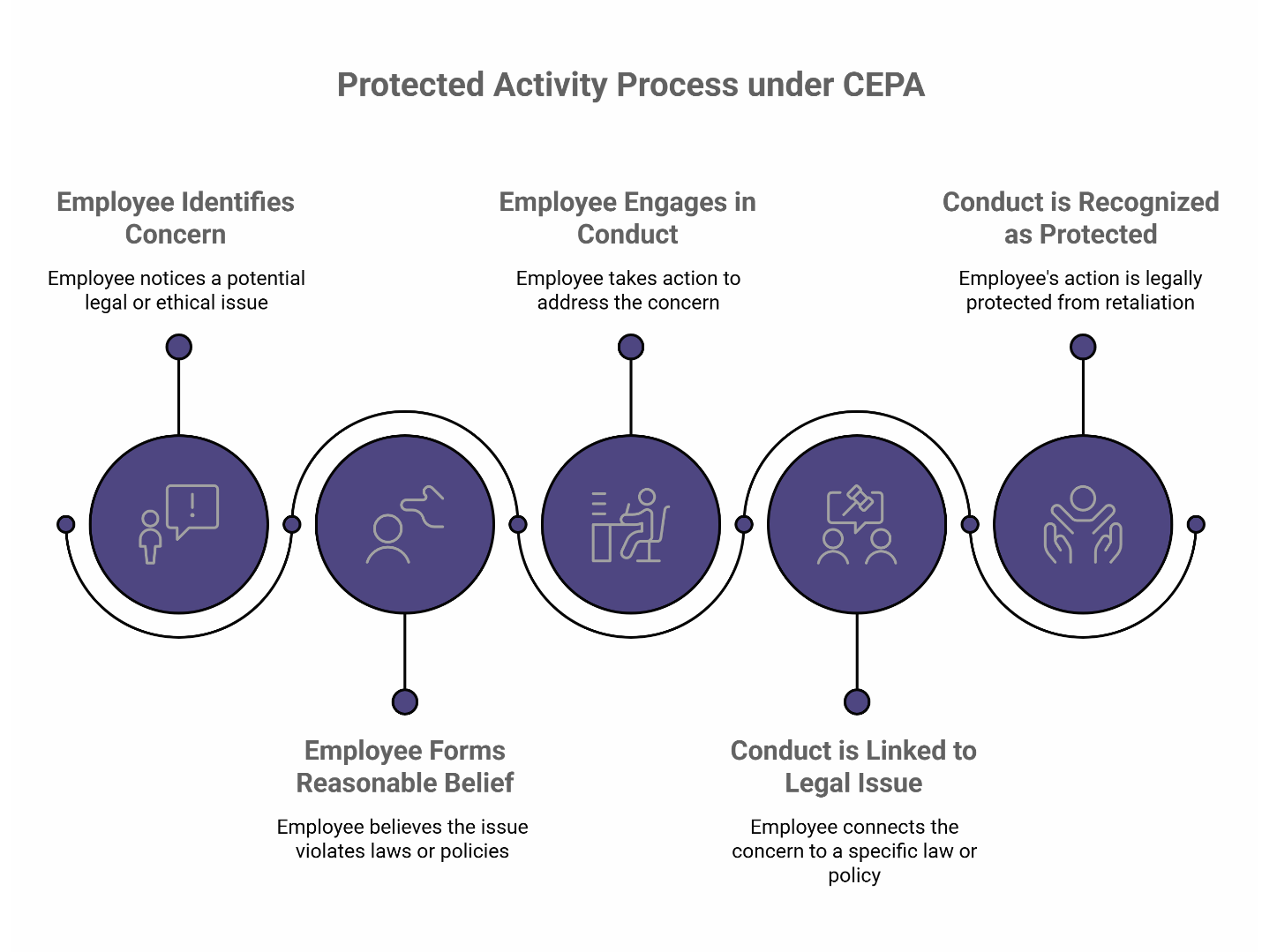
That framework matters in healthcare workplaces because a concern may arise in the middle of ordinary job duties. A report, an objection, or a refusal may look like a workplace disagreement on the surface. In some circumstances, however, the concern may also involve a legal or public-policy issue, or, for licensed or certified healthcare professionals, improper quality of patient care. The legal character of the concern often matters more than the label attached to the disagreement.
A separate question is whether the underlying concern can be linked to a law, a rule, a regulation, fraudulent conduct, a clear mandate of public policy, or, where the statute specifically applies, improper quality of patient care. That distinction often determines whether the conduct may fall within the category of protected activity.
Types of Conduct That May Fall Within the Concept
Under New Jersey law, protected activity may include more than one kind of conduct. The statute may recognize conduct such as the following when the required legal conditions are present:
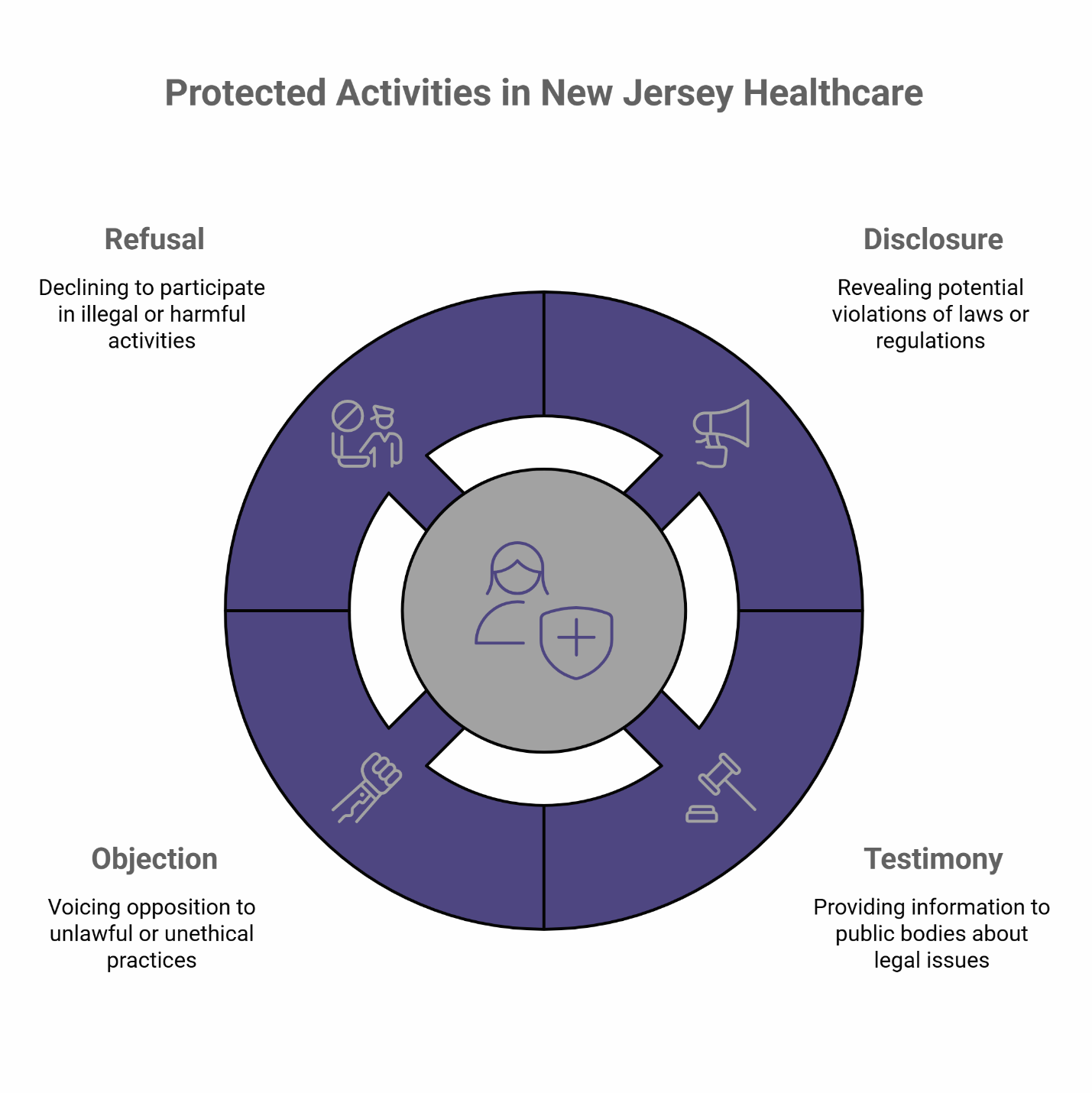
- An employee may disclose, or threaten to disclose, an activity, policy, or practice when the employee reasonably believes it may violate a law, rule, or regulation, or, in the case of a licensed or certified healthcare professional, reasonably believes it constitutes improper quality of patient care.
- An employee may provide information to, or testify before, a public body about conduct that the employee reasonably believes may be legally significant under the statute, including inquiries into the quality of patient care.
- An employee may object to an activity, policy, or practice that the employee reasonably believes may be unlawful, fraudulent, incompatible with a clear mandate of public policy, or constitutes improper quality of patient care.
- An employee may refuse to participate in conduct that the employee reasonably believes may violate a law, involve fraud or criminal conduct, conflict with a clear mandate of public policy concerning public health, safety, or welfare, or constitutes improper quality of patient care.
In healthcare settings, those categories may arise when an employee raises concerns tied to record integrity, regulatory compliance, or the quality of patient care. That does not necessarily mean every internal complaint qualifies. New Jersey law may distinguish between a legally significant objection and a complaint that reflects frustration without a clear legal, public-policy, or patient-care component.
Hypothetical example: A New Jersey healthcare employee raises an internal concern because the employee reasonably believes certain conduct may conflict with legal, regulatory, or patient-care obligations. This hypothetical example illustrates only the general concept of protected activity and does not predict how any specific matter would be evaluated.
The practical implication is straightforward. A whistleblower analysis usually begins with the nature of the employee’s conduct and the subject of the concern, not with the employer’s later explanation alone.
What Often Falls Outside the Concept
Not every workplace conflict becomes protected activity. Ordinary disagreement, interpersonal tension, management friction, or general dissatisfaction usually does not fall within the concept unless the conduct is connected to a reasonably perceived legal, regulatory, fraud-related, public-policy, or patient-care issue.
For example, a complaint about communication style, staffing friction, favoritism, or day-to-day supervision may remain an ordinary employment dispute if the complaint does not identify a legally significant concern. A worker may feel unfairly treated, excluded, or pressured. Those experiences may be serious. By contrast, CEPA generally focuses first on whether the employee engaged in conduct that the statute may recognize as protected activity.
That distinction matters because retaliation law does not convert every workplace grievance into a whistleblower matter. The threshold issue is whether the employee’s conduct may belong in that legal category at all.
Why the Line Can Feel Unclear in Healthcare Workplaces
Healthcare workplaces often place legal duties, professional judgment, and institutional pressure in the same setting. A concern may appear operational at first, yet the same concern may also implicate a law, a regulation, fraudulent conduct, a clear mandate of public policy, or, for licensed or certified healthcare professionals, improper quality of patient care. In some circumstances, that overlap makes the phrase protected activity feel less obvious than it sounds.
The timing can also create confusion. An employee may recognize discipline, suspension, or termination immediately. The earlier conduct may be harder to classify. A worker may know that a concern was raised in good faith, yet still be unsure whether New Jersey law may treat that conduct as protected activity. In this context, the legal issue is often narrower than the workplace experience. The question is whether the employee’s disclosure, objection, refusal, or participation may fall within the category recognized by the statute.
Closing Perspective
For New Jersey healthcare workers, protected activity may include more than speaking up in a general sense. The concept may extend to certain disclosures, objections, refusals, and participation in an inquiry when the conduct is tied to a reasonable belief about unlawful conduct, fraud, a clear mandate of public policy, or, where the statute specifically applies, improper quality of patient care. By contrast, an ordinary workplace dispute, standing alone, usually does not fit that framework.
Because the difference between protected activity and an ordinary workplace dispute can be fact-specific, a qualified New Jersey whistleblower attorney can evaluate the details of a particular situation.
Have Questions About Protected Activity Under New Jersey Law?
If you are a healthcare worker facing discipline, suspension, or termination after raising concerns, Zatuchni & Associates may be able to help you better understand whether your situation could involve protected activity under CEPA and what legal issues may matter most. As one of New Jersey’s leading employment law firms, our team handles matters involving wrongful termination and other workplace protections with the careful, fact-specific attention these cases often require.
If you would like to discuss your situation, contact us today for a confidential conversation. You can also explore our website to learn more about our New Jersey employment law services and the workplace protections that may be available to you.
You must be logged in to post a comment.