
📌 Key Takeaways
Under New Jersey law, a report of suspected Medicare-related misconduct may raise a whistleblower-retaliation issue when protected activity is followed by adverse employment action.
- Protected Activity Matters: Good-faith reports of suspected Medicare billing irregularities, compliance failures, or related misconduct may carry different legal significance than general workplace complaints.
- Employer Response Counts: Termination, suspension, demotion, reduced duties, or lost pay may matter more than workplace friction when evaluating possible retaliation.
- Sequence Shapes Analysis: When a materially negative job action follows potentially protected activity, the timing and surrounding facts may support a retaliation analysis.
- CEPA May Govern: CEPA may be central in New Jersey, even when the reported conduct involves Medicare-related issues tied to a federal program.
- Federal Overlap Is Limited: A federal anti-retaliation provision may apply in some false-claims contexts, but not every Medicare-related report falls within it.
The report, the employer’s response, and the governing law may determine whether a workplace dispute becomes a whistleblower-retaliation question.
New Jersey healthcare workers concerned about retaliation after reporting suspected Medicare-related misconduct will gain clearer issue recognition here, guiding them into the whistleblower-specific details that follow.
~ ~ ~ ~ ~ ~ ~ ~ ~ ~ ~ ~ ~ ~ ~ ~ ~ ~
A New Jersey healthcare worker who reports suspected Medicare-related misconduct and then faces termination, suspension, demotion, or another materially negative job consequence may be dealing with a whistleblower-retaliation issue. Under New Jersey law, generally, the analysis may turn on three questions. First, did the worker engage in protected activity? Second, did the employer impose an adverse employment action? Third, does New Jersey law, federal law, or both potentially apply? Those questions often determine whether a report of suspected Medicare-related misconduct may have legal significance beyond an ordinary workplace dispute.
When a Report of Suspected Medicare-Related Misconduct May Qualify as Protected Activity
Under New Jersey law, generally, protected activity may include a good-faith report of conduct that an employee reasonably believes is unlawful, fraudulent, improper, or contrary to a clear mandate of public policy. In a healthcare setting, that conduct may involve suspected Medicare billing irregularities, coding concerns, compliance failures, or related organizational misconduct. A complaint about interpersonal tension or generalized dissatisfaction, by contrast, may not raise the same legal issue.
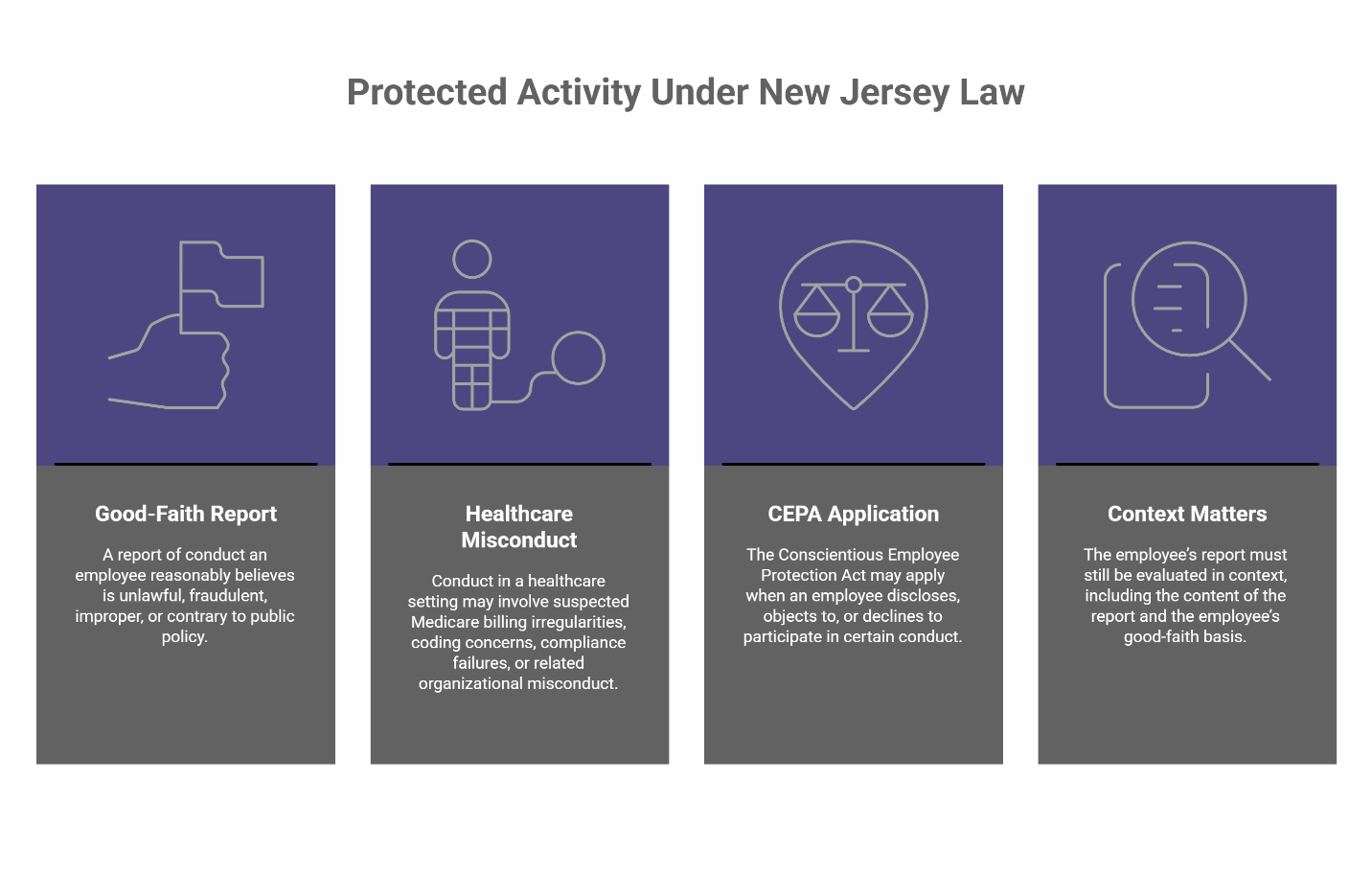
The Conscientious Employee Protection Act, or CEPA, N.J.S.A. 34:19-1 et seq., may be the central New Jersey law in this setting. CEPA may apply when an employee discloses, objects to, or declines to participate in certain conduct under circumstances defined by the statute. The employee’s report must still be evaluated in context. The content of the report may matter. The employee’s good-faith basis may matter. The law does not treat every workplace complaint as protected activity. That distinction matters because a retaliation analysis usually begins with whether the employee engaged in conduct the law may protect.
When an Employer’s Response May Amount to an Adverse Employment Action
A retaliation analysis usually focuses on what the employer did after the employee reported suspected Medicare-related misconduct. An adverse employment action may include termination, suspension, demotion, a significant reduction in duties, or a materially negative change in pay or job status. Those examples are illustrative, not exhaustive.
An employee’s anxiety after making a report may be real and understandable, especially in a healthcare workplace where reporting lines, compliance duties, and professional standing can carry serious consequences. The legal question, however, usually turns on the employer’s conduct. An employer may impose formal discipline. An employer may reduce an employee’s responsibilities. An employer may cut pay or remove the employee from a position. When a materially negative action follows potentially protected activity, the sequence may support a retaliation analysis, although timing alone does not resolve the issue.
The surrounding facts also matter. The law may examine the nature of the report, the seriousness of the employer’s response, and the connection between the two events. That sequence matters because an employer’s adverse action, standing alone, may be only an employment decision, while an adverse action that follows protected activity may raise a retaliation question.
When CEPA or Federal Anti-Retaliation Law May Apply
A report about Medicare-related misconduct may sound exclusively federal, but New Jersey law may still govern much of the employment analysis. The reported conduct may involve billing or compliance tied to a federal program, while the worker’s retaliation claim may still depend primarily on CEPA.
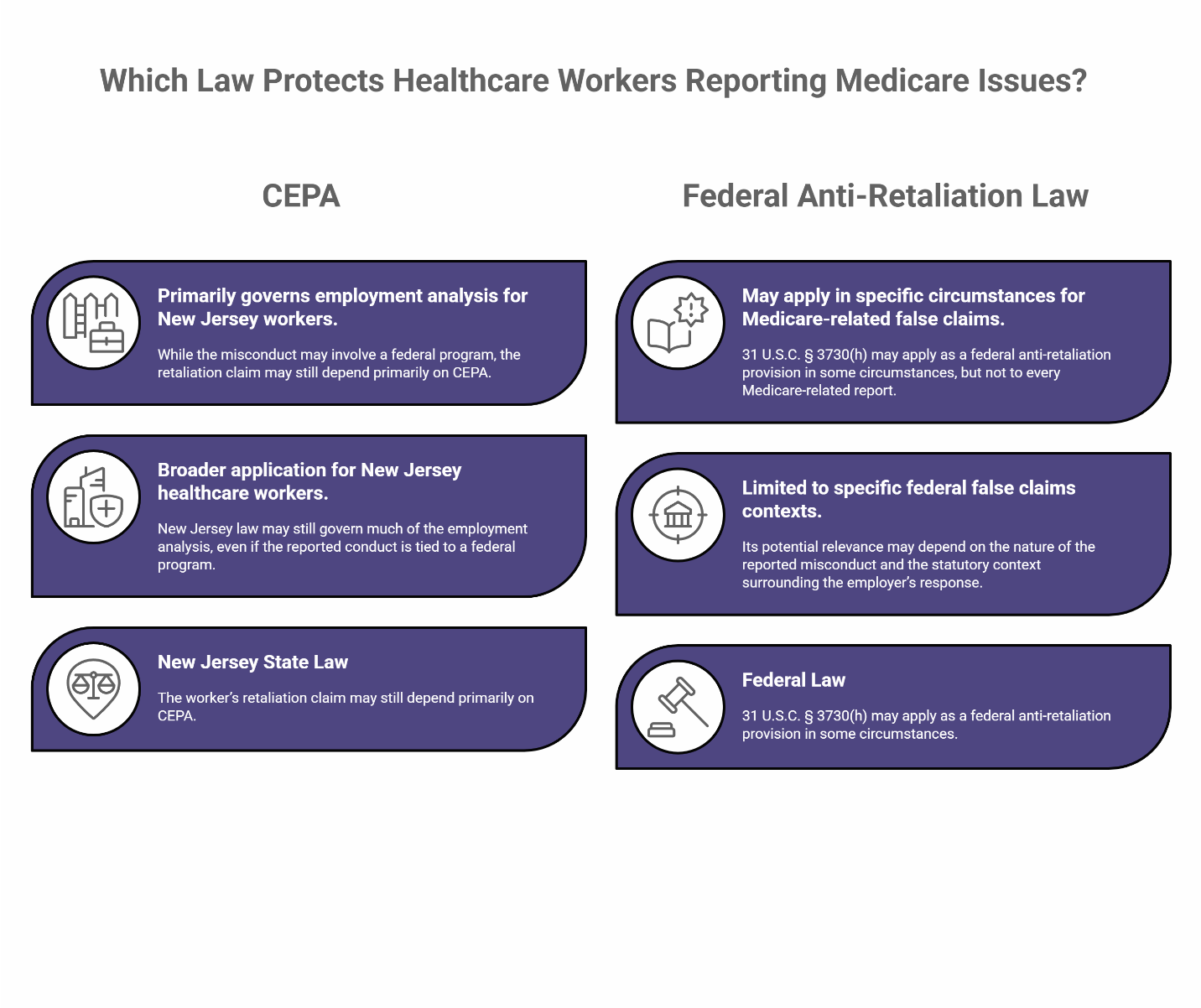
Limited federal overlap may also exist. When the reported misconduct may involve false claims connected to Medicare, 31 U.S.C. § 3730(h) may apply as a federal anti-retaliation provision in some circumstances. That federal law does not apply to every Medicare-related report. Its potential relevance may depend on the nature of the reported misconduct and the statutory context surrounding the employer’s response.
A simple hypothetical shows why the distinction matters. A New Jersey healthcare employee reports suspected Medicare billing irregularities in good faith. The employer later demotes the employee and reduces the employee’s pay. That sequence may raise questions about protected activity, adverse employment action, and whether CEPA, a federal anti-retaliation law, or both may apply. This hypothetical is illustrative only and does not determine whether any real situation is legally protected.
Why Similar Reports and Employer Responses May Be Treated Differently
Two New Jersey healthcare workers may report similar suspected Medicare-related misconduct and still receive different legal treatment. One worker may describe conduct that fits more closely within a statute the law recognizes. Another worker may raise a sincere concern that does not fit the same statutory category. One employer may terminate or demote the worker after the report. Another employer may create workplace friction without imposing a materially negative employment action.
Healthcare workers often understand the operational significance of a compliance problem before they understand its legal significance. A nurse, physician, billing coder, or clinical staff member may recognize that something appears wrong without knowing whether the report may qualify as protected activity or whether the employer’s response may amount to retaliation. That difference matters because similar concerns do not always create the same legal issue under the law.
Conclusion
A report of suspected Medicare-related misconduct may raise a whistleblower-retaliation issue under New Jersey law when the employee engaged in potentially protected activity and the employer later imposed a materially negative employment action. CEPA may be the central New Jersey law in that analysis, and limited federal overlap may exist in some cases involving false claims. Because the law may treat similar reports and employer responses differently based on the facts and the governing statute, consultation with a qualified employment law attorney may help clarify whether New Jersey law or a related federal anti-retaliation provision may apply.
Frequently Asked Questions
What kinds of reports may count as protected activity in a New Jersey healthcare setting?
Under New Jersey law, generally, reports of suspected fraud, Medicare billing irregularities, compliance failures, or other misconduct may come closer to protected activity than complaints based only on workplace dissatisfaction. The legal significance of the report may depend on what the employee reported, why the employee believed the conduct was improper, and which law may apply.
When may attorney review become especially important after a Medicare-related report?
Attorney review may become especially important when an employer follows a report of suspected Medicare-related misconduct with termination, suspension, demotion, reduced pay, or another materially negative employment action. Those facts may require statute-specific analysis because CEPA and any related federal anti-retaliation law may not apply in the same way to every situation.
Could internal reporting alone still raise whistleblower-retaliation issues?
Internal reporting alone may still raise whistleblower-retaliation issues in some circumstances. The legal analysis may depend on the nature of the reported misconduct, the employee’s good-faith basis for the report, the employer’s response, and the law that may govern the situation.
Why may similar Medicare-related concerns receive different legal treatment?
Similar concerns may receive different legal treatment because the law may focus on different facts in each situation. The content of the report may differ. The employer’s response may differ. The governing statute may also differ. Those differences may change whether the law treats the matter as protected activity followed by retaliation.
Legal Notice: This content provides general information about New Jersey whistleblower-retaliation issues and is not legal advice. Laws are subject to change. Strict deadlines apply to legal claims, and these deadlines vary. You should speak with an attorney as soon as possible about any time limits that may apply to your situation.
Protect Your Position With Experienced New Jersey Employment Counsel
If you are facing demotion, suspension, termination, or other workplace consequences after reporting suspected Medicare-related misconduct, Zatuchni & Associates is here to help you better understand your rights and possible next steps under New Jersey employment law. As one of the leading employment law firms in New Jersey, our team assists workers in matters involving whistleblower retaliation, wrongful termination, discrimination, and other workplace protections.
To discuss your situation in a supportive, confidential setting, contact us today. You can also explore our website to browse more resources on employment protections and related workplace issues in New Jersey.
You must be logged in to post a comment.