
Article at a Glance
📌 Key Takeaways
Quota-based retaliation concerns may arise when a New Jersey employer materially changes productivity enforcement after an employee engages in potentially protected activity.
New Jersey warehouse employees can use the distinctions below to understand when ordinary performance management may take on a materially different context.
- Changed Enforcement Matters: The central concern is whether standards are applied differently after an employee reports discrimination, requests accommodation, or files a harassment complaint.
- Context Determines Significance: A demanding quota or critical supervisor does not establish retaliation without broader context about timing, changed treatment, and resulting employment consequences.
- Consequences May Escalate: Formal warnings, reduced hours, less desirable assignments, suspension, denied advancement, or termination may place productivity enforcement in a more serious context.
- Comparisons Provide Context: Treatment before and after potentially protected activity may show whether comparable performance variations began producing unusually severe scrutiny or formal discipline.
- Legitimate Reasons Remain Possible: Operational changes may explain stricter standards, so no single circumstance necessarily establishes retaliatory intent, causation, or employer liability.
Changed productivity enforcement may raise concerns, but the complete workplace context determines its significance.
~ ~ ~ ~ ~ ~ ~ ~ ~ ~ ~ ~ ~ ~ ~ ~ ~ ~
A warehouse productivity quota is not inherently retaliatory. A different concern may arise when a New Jersey employer materially changes an employee’s productivity expectations, scrutiny, or discipline after the employee engages in discrimination-related conduct that may constitute protected activity under the New Jersey Law Against Discrimination (NJLAD). Protected activity under the NJLAD includes opposing illegal discrimination—such as reporting racist comments, requesting a disability accommodation, or filing a formal sexual harassment complaint with human resources.
Employers may establish, modify, and enforce productivity standards for legitimate operational or performance-related reasons. The potential retaliation concern arises when an employer materially changes how those standards are applied to an employee after potentially protected activity and then uses the productivity system in connection with unfavorable workplace treatment.
This discussion does not characterize productivity quotas as unlawful under a New Jersey warehouse-specific quota statute. The focus is potential workplace retaliation in New Jersey involving the application or enforcement of productivity metrics.
When Ordinary Productivity Metrics Begin to Feel Punitive
Warehouses may measure work through production rates, output targets, item counts, or other performance metrics. Those measurements can serve ordinary management purposes.
An employee may become concerned when a supervisor applies those standards differently after the employee raises a discrimination-related complaint that may constitute protected activity. A supervisor may examine the employee’s numbers more closely, respond more severely to ordinary performance variations, or rely on productivity figures when making materially unfavorable employment decisions.
A demanding target, critical supervisor, or disappointing evaluation does not establish retaliation by itself. The context may include what the employer changed, when the change occurred, and what employment consequences followed.
A Sudden Change in How Productivity Standards Are Applied
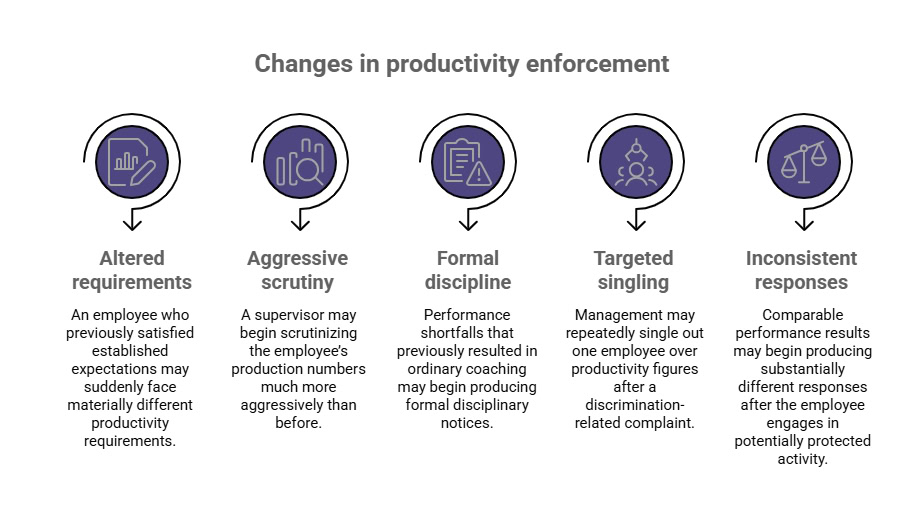
Changes in productivity enforcement may appear in several illustrative, non-exhaustive ways:
- An employee who previously satisfied established expectations may suddenly face materially different productivity requirements.
- A supervisor may begin scrutinizing the employee’s production numbers much more aggressively than before.
- Performance shortfalls that previously resulted in ordinary coaching may begin producing formal disciplinary notices.
- Management may repeatedly single out one employee over productivity figures after a discrimination-related complaint.
- Comparable performance results may begin producing substantially different responses after the employee engages in potentially protected activity.
These circumstances may explain why an employee questions a change in treatment. They do not, individually or collectively, establish unlawful retaliation without consideration of the broader facts.
When Productivity Numbers Produce Material Workplace Consequences
An employer’s change in productivity enforcement may become more consequential when the employer uses production numbers as the stated basis for materially unfavorable treatment.
A formal warning can affect an employee differently from routine coaching. A negative performance evaluation can carry additional significance when it follows a marked increase in scrutiny. Reduced scheduled hours, less desirable assignments, reassignment, suspension, denial of advancement, or termination may also place the productivity dispute in a more serious employment context.
Adverse action is a legal term that may apply to materially unfavorable employment treatment, depending on the circumstances. In a warehouse setting, this could look like assigning a worker to a physically heavier picking lane, reducing their scheduled shifts, or issuing a final written warning that disqualifies them from peak-season bonuses. Identifying an adverse action does not, by itself, establish retaliation.
Strict Performance Management and Retaliation Concerns Are Different
Employers have legitimate interests in maintaining productivity and addressing actual performance problems. Workflow demands may change. Production requirements may increase. Management may also apply closer supervision when genuine performance concerns arise.
For that reason, stricter expectations following a discrimination-related complaint do not automatically amount to retaliation.
A different concern may arise when an employer materially changes how it applies productivity standards to a particular employee after potentially protected activity and then relies on those standards when imposing unfavorable employment consequences. The significance of that sequence depends on the specific workplace facts.
Treatment Before and After a Complaint Can Provide Important Context
An employee’s prior experience with a productivity system can affect how later enforcement appears.
An employee may have worked under consistent production expectations for an extended period before engaging in potentially protected activity. Similar fluctuations in output may previously have resulted in ordinary feedback rather than discipline. Management may then begin responding much more severely to comparable performance after the discrimination-related complaint.
That contrast does not establish retaliatory intent. It provides factual context for understanding why an employee may view the later enforcement as materially different from ordinary performance management.
The underlying workplace issue may involve conduct addressed by New Jersey anti-discrimination law, which is part of the firm’s broader New Jersey employment-law practice.
Selective or Unusually Aggressive Enforcement Can Alter the Workplace Dispute
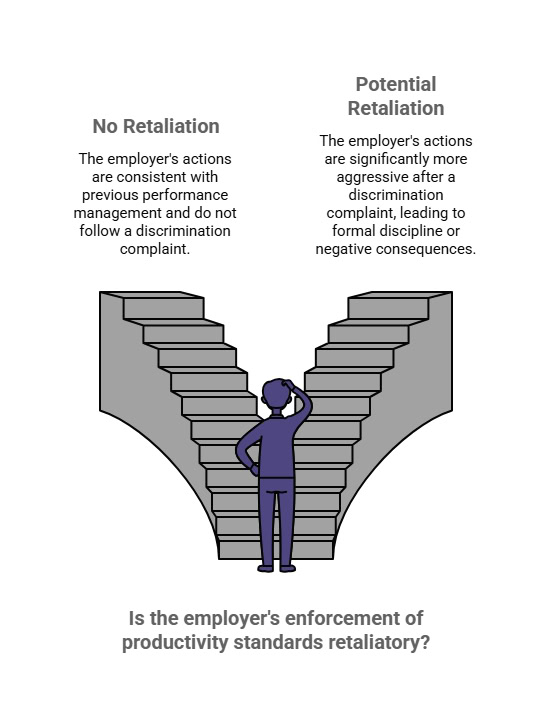
An employer may maintain a facially neutral productivity system while applying that system much more aggressively to one employee after a discrimination-related complaint.
A supervisor might repeatedly criticize that employee’s production figures, issue formal discipline for results that previously produced no comparable response, or rely on those figures when making a reassignment or termination decision. In that situation, the concern involves how the employer applies and uses the productivity system rather than the existence of performance standards themselves.
Differential enforcement may provide relevant context. It does not automatically establish retaliation.
Illustrative Example
A New Jersey warehouse employee works under the same productivity expectations for an extended period without serious performance discipline. The employee later reports what the employee believes is unlawful discriminatory treatment to management.
Soon afterward, the supervisor begins imposing substantially more demanding productivity expectations on that employee and repeatedly cites the employee’s numbers when issuing formal discipline.
The change could raise a retaliation concern when materially different treatment follows the discrimination-related complaint. The sequence alone does not establish retaliatory intent, causation, or employer liability.
Productivity-Based Retaliation Concerns Can Develop Before Termination
A retaliation concern does not have to begin with termination. An employee may first experience intensified scrutiny or unusually severe performance criticism before an employer later uses productivity figures as the stated basis for a materially unfavorable employment decision.
The concern therefore centers on how an employer applies and uses the productivity system after potentially protected activity, not merely on whether the workplace expects employees to meet demanding standards.
Why These Situations Are Highly Fact-Specific
Productivity systems can serve legitimate workplace purposes, and changes in expectations or enforcement do not automatically amount to retaliation.
The significance of a particular situation may depend on the employee’s treatment before potentially protected activity, the employer’s later changes in productivity enforcement, the employer’s stated performance reasons, and the employment consequences that followed. No single circumstance necessarily determines whether unlawful retaliation occurred.
Concerned About Workplace Retaliation? Let’s Talk Through Your Options
Workplace retaliation can be stressful, confusing, and hard to face alone. Zatuchni & Associates helps employees in New Jersey understand whether an employer’s actions may qualify as unlawful retaliation and what options may be available.
If you are in Newark, Jersey City, Trenton, Princeton, Hackensack, Edison, New Brunswick, Elizabeth, or a nearby area, you are welcome to reach out for a Free Case Review.
Contact Us Today to speak with a workplace retaliation lawyer and take a calm, informed next step.
You can also connect with Zatuchni & Associates on Facebook or X.
This material provides general information and does not constitute individualized legal advice. Workplace retaliation matters depend on specific facts, applicable law may change, and strict legal deadlines may apply and may vary. A New Jersey employment attorney can evaluate questions concerning an individual’s circumstances and any timing issues that may apply.
You must be logged in to post a comment.