
📌 Key Takeaways
In New Jersey retaliation discussions after a harassment complaint, pretext centers on whether “performance issues” are unworthy of credence and conceal actual motivation.
- Pretext Targets Credibility: Pretext can be argued when “performance issues” are challenged as unworthy of credence and concealing the employer’s actual motivation.
- Performance Can Be Routine: Performance management can be routine, so post-complaint criticism may reflect ordinary oversight rather than retaliation, depending on surrounding circumstances.
- Consistency Shapes Disputes: Shifting rationales over time can fuel credibility disputes, especially when the employer’s stated motivation changes without a clear explanation.
- Expectations And Records Matter: Discussion themes may include newly emphasized expectations, different applications of standards, or tension with prior feedback and evaluations after protected activity.
- Themes Stay Conceptual: These themes remain illustrative, not a checklist, and New Jersey NJLAD retaliation discussions are typically fact-specific, with strict deadlines for legal claims.
Consistency, context, and credibility shape how “performance issues” are discussed after protected activity.
New Jersey employees who reported workplace harassment or joined a harassment-related process will gain sharper context here, preparing them for the detailed overview that follows.
When performance criticism or performance-based discipline appears after a workplace harassment complaint, pretext often becomes part of how retaliation issues are discussed in New Jersey employment matters. Pretext refers to a false or misleading reason given to justify a workplace decision—where “performance issues” are presented as the reason, but that explanation is contested as hiding the employer’s actual motivation. While often discussed as a dispute, legally, pretext exists when the stated reason is shown to be unworthy of credence.
This overview stays conceptual. It explains how pretext may be framed when performance becomes the employer’s stated motivation after protected activity, and it explains how this concept fits within the broader theme of work feeling different after reporting.
Understanding “Pretext” in Retaliation Discussions After Harassment Reports
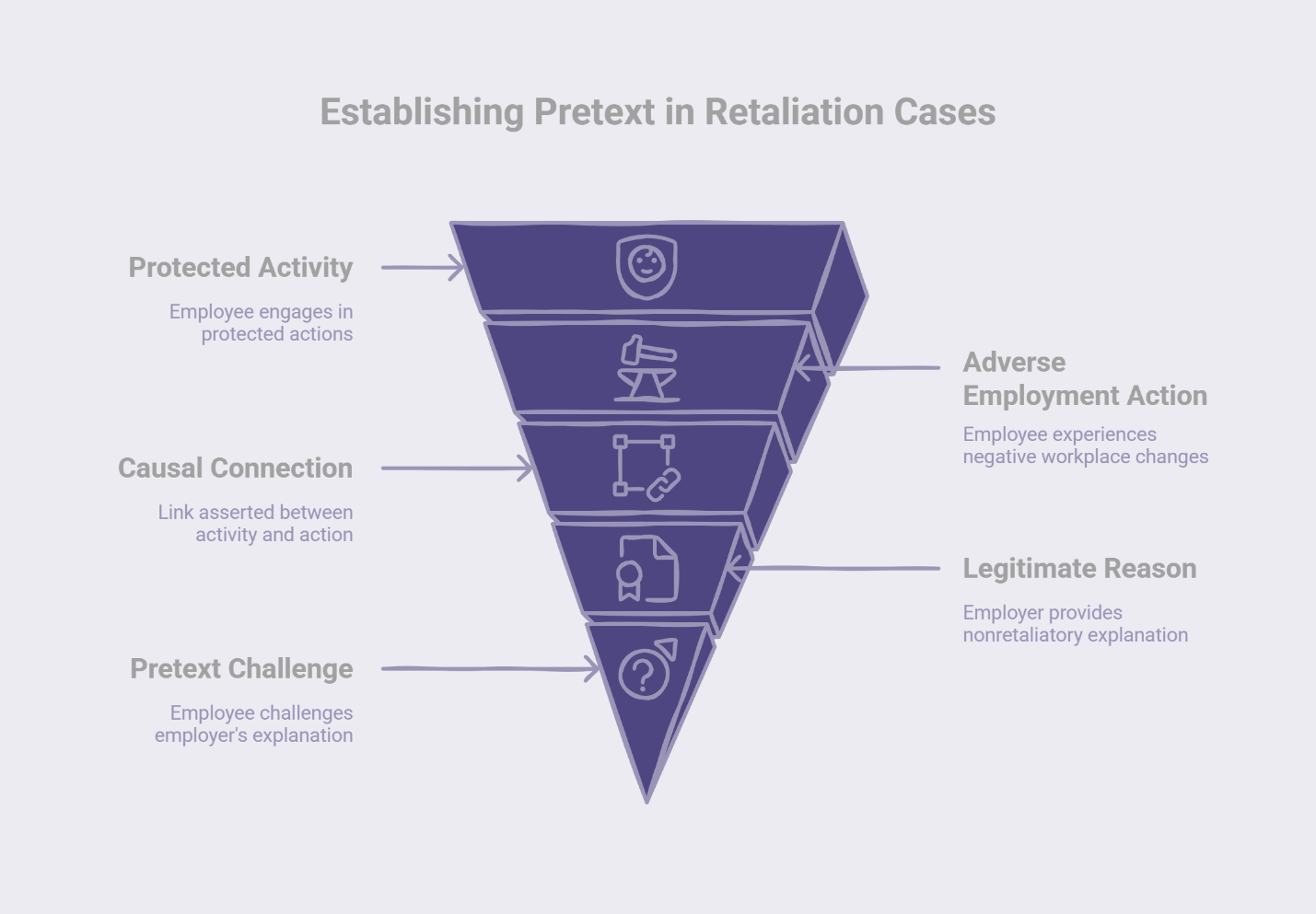
Retaliation discussions often use terms of art that describe the relationship between a harassment report and later workplace actions.
Protected activity includes reporting workplace harassment, supporting another person’s harassment report, or participating in a harassment-related complaint or investigative process. An adverse employment action may be discussed as a materially negative workplace action, such as a meaningful change in job conditions, responsibilities, advancement prospects, or discipline. A causal connection refers to an asserted link between the protected activity and the challenged action. A legitimate nonretaliatory reason is the employer’s stated motivation that it asserts is not retaliatory. Pretext refers to the falsity of that explanation—where the stated motivation is challenged as unworthy of credence and a cover for the employer’s actual motivation.
Establishing pretext does not always rely on a single fact to resolve a dispute. Instead, proving pretext often requires demonstrating a credibility disagreement about why a decision occurred. In many discussions, that credibility disagreement centers on whether the employer’s explanation stays consistent over time and aligns with surrounding circumstances.
Key takeaways
- Pretext describes a false or fabricated reason offered to hide an employer’s actual motivation, not merely the dispute itself.
- Pretext discussions often focus on consistency and context rather than isolated details.
Why “Performance” Is Commonly Offered as an Explanation After a Complaint
Performance management can be routine in many workplaces. Employers often evaluate work quality, productivity, reliability, and adherence to internal standards. A post-complaint performance conversation can reflect ordinary management activity in some settings.
Disputes may arise when a performance narrative becomes more prominent after protected activity. In some situations, an employer’s description of performance concerns may shift in timing, tone, or formality after a harassment report or participation in a related process. In other situations, documentation or discipline may appear after protected activity in a way that becomes contested as retaliatory in motivation.
In that setting, counsel may frame the dispute around the employer’s asserted legitimate nonretaliatory reason and whether that explanation is contested as pretext. Performance can be a common stated motivation, while still being disputed depending on the circumstances. A harassment lawyer may describe these issues using the same core terms of art while keeping the analysis tied to the full context.
Key takeaways
- Routine performance management and a contested explanation are different concepts.
- Post-complaint performance explanations sometimes become central because they often serve as the employer’s stated motivation for later actions.
Overview of Pretext Discussions When “Performance Issues” Are the Stated Motivation
When “performance issues” are offered as the stated motivation after protected activity, certain credibility themes may come up in discussion. These themes are illustrative rather than exhaustive, and they do not operate as a checklist.
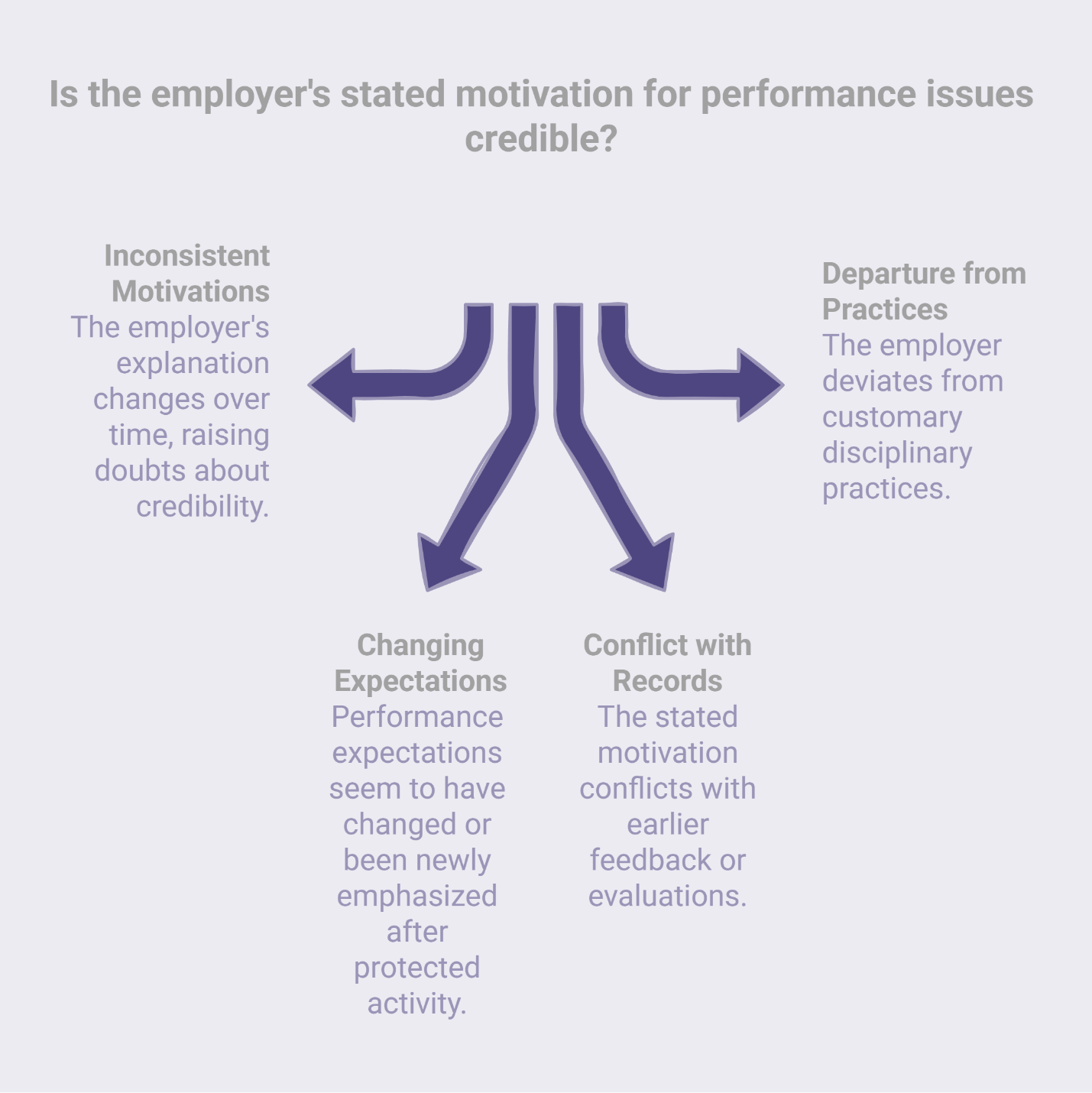
Consistency of stated motivations. A dispute may develop when the employer’s explanation changes over time, such as when one rationale appears first and a different rationale appears later without a clear explanation for the shift.
Stated expectations and their application. A discussion may form around whether performance expectations were described as longstanding or whether they appear to have changed, been newly emphasized, or been applied differently after protected activity.
Fit with surrounding records and context. A stated performance motivation may be contested when it appears to conflict with earlier feedback, prior evaluations, or earlier treatment, particularly where the change in narrative follows protected activity.
Consistency in approach. Workplaces often follow customary ways of communicating, documenting, and administering discipline. A departure from customary practices may be discussed as part of a broader dispute about whether the stated motivation reflects the actual motivation.
Key takeaways
- Pretext themes may include consistency, expectation-setting, and alignment with surrounding circumstances.
- These themes describe how credibility disputes are framed; outcomes depend on fact-specific analysis.
Hypothetical example (for illustration only).
An employee participates in a harassment-related investigative process. After that participation, a supervisor issues a written performance warning that cites “communication problems.” Later, the employer describes the same decision as based on “missed deadlines,” and later still as based on “teamwork concerns,” without explaining why the stated motivation changed. In a retaliation discussion, that sequence may be cited as evidence of pretext because the employer’s stated motivation is inconsistent and potentially unworthy of belief.
Conclusion
Pretext is a concept used to describe a false justification masking an employer’s actual motivation, and performance-based explanations often sit at the center of that dispute when workplace dynamics shift after protected activity. In New Jersey retaliation discussions under the New Jersey Law Against Discrimination (NJLAD), the analysis is typically fact-specific, and general descriptions of these concepts may apply differently depending on the circumstances.
Disclaimer: This post provides general informational and educational content only and does not constitute legal advice. Reading this post does not create an attorney–client relationship. Laws and interpretations may change over time, and how general concepts apply may vary based on specific facts.
“Strict deadlines apply to legal claims, and these deadlines vary. You should speak with an attorney as soon as possible about any time limits that may apply to your situation.”
If someone is in immediate danger or facing threats, they should contact local emergency services.
FAQs
What does “pretext” mean in a New Jersey retaliation discussion involving a harassment complaint?
Pretext refers to a false or pretextual reason given by an employer, where the explanation offered for a workplace action is challenged as hiding the actual, retaliatory motivation.
Why do “performance issues” sometimes become the stated reason after a complaint?
Performance is a common way employers describe workplace decisions. In some disputes, that performance-based explanation becomes contested after protected activity, and the dispute is framed around whether the stated motivation aligns with the broader context.
FUQs
Why can consistency of explanations become an important theme in retaliation disputes?
Consistency often relates to credibility. When an employer’s stated motivation shifts over time, those changes may become part of a broader dispute about whether the stated motivation reflects the actual motivation.
How can retaliation discussions differ from ordinary disagreements about performance?
Retaliation discussions commonly involve an asserted link between protected activity and an adverse employment action, while ordinary performance disagreements typically focus on expectations and evaluations without that asserted causal connection.
Talked to HR and Now Facing “Performance Issues”? Let’s Talk.
At Zatuchni & Associates, we’ve spent decades helping New Jersey employees navigate the complexities of workplace retaliation and pretextual discipline. If you reported harassment and are now seeing a sudden shift in how your performance is treated, you don’t have to face it alone.
We specialize in employment law—with proven experience in retaliation claims, wrongful termination, and harassment cases under the New Jersey Law Against Discrimination (NJLAD). Our legal team understands how credibility disputes and shifting explanations can impact your rights and career. Contact us today to discuss your situation in a confidential consultation. Whether you’re seeking clarity, validation, or legal action, we’re here to help you move forward.
You must be logged in to post a comment.