
📌 Key Takeaways
New Jersey hourly warehouse workers may have a retaliation concern when protected wage complaints are followed by significant adverse employment actions.
- Presumption Has Limits: A 90-day presumption may arise after a covered filing with the Commissioner or court, but not from an internal complaint alone.
- Internal Complaints May Qualify: New Jersey law may protect certain wage-related complaints made directly to an employer, even without citing a specific law.
- Material Changes Matter: Reduced hours, serious discipline, reassignment, demotion, or termination may raise concerns when they follow a protected wage complaint.
- Context Can Change Conclusions: Timing may support concern, but employers may identify independent reasons involving workflow, attendance, performance, conduct, equipment, or operational demand.
- Records Clarify Disputes: Complaints, messages, pay stubs, time records, schedules, written notices, and dated timelines may help connect workplace changes with stated reasons.
For New Jersey hourly warehouse workers, the path forward requires assessing the protected complaint, timing, employment change, and employer’s explanation together.
~ ~ ~ ~ ~ ~ ~ ~ ~ ~ ~ ~ ~ ~ ~ ~ ~ ~
A New Jersey hourly warehouse employee who raises a genuine concern about unpaid or incomplete wages and later experiences an adverse employment action may have a retaliation concern. New Jersey law protects certain wage-related complaints, and a 90-day presumption may apply when a worker files a wage-and-hour complaint with the Commissioner of Labor and Workforce Development or when a covered claim is brought in court by or for the worker.
For an hourly employee, reduced hours, serious discipline, reassignment, demotion, or termination can reduce income or threaten continued employment. Those changes can also result from lawful operational or personnel decisions, so the full context matters.
Why Retaliation Concerns May Arise After Certain Wage Complaints
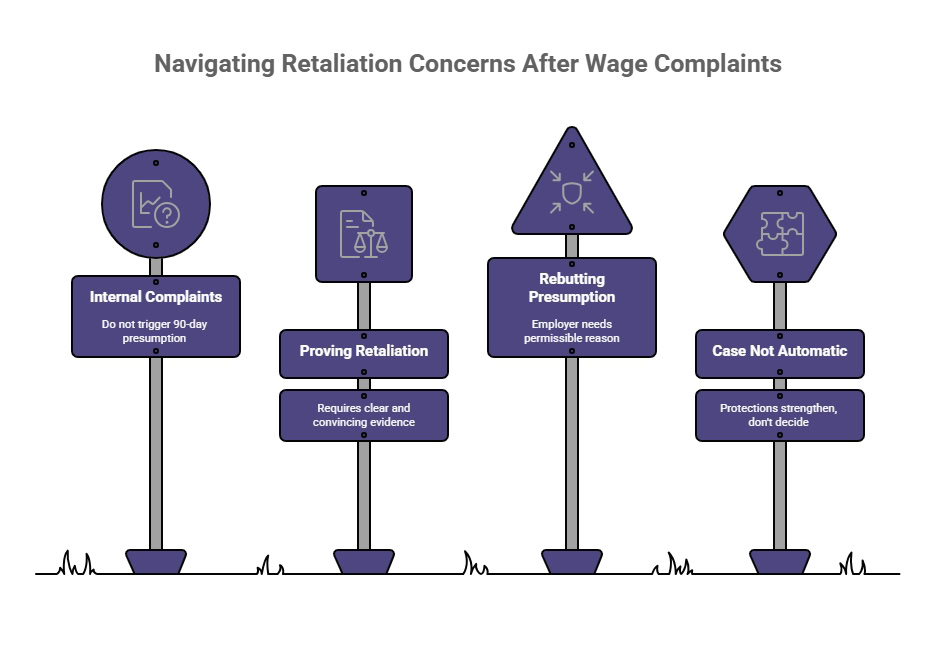
State law (N.J.S.A. 34:11-56a24) protects workers from retaliation for wage-and-hour complaints, while a related statute (N.J.S.A. 34:11-4.10) provides similar safeguards for disputes over wage payments. Both statutes can protect certain complaints made directly to an employer, and the complaint does not have to cite a specific law.
Under N.J.S.A. 34:11-56a24, an adverse action taken within 90 days after an employee files a wage-and-hour complaint with the Commissioner of Labor and Workforce Development, or after a covered claim or action is brought in court by or for the employee, is presumptive evidence that the employer knowingly retaliated. N.J.S.A. 34:11-4.10 contains a similar rule for covered wage-payment claims and, in a civil action, requires clear and convincing evidence of another permissible reason to rebut the presumption. These rules can strengthen a worker’s position, but they do not automatically decide the case. An internal complaint alone does not trigger the 90-day presumption. However, if retaliation is proven, New Jersey law provides strong statutory protections, which may include the recovery of lost wages plus up to 200% in liquidated damages, and claims can be filed up to six years after the retaliatory act
An Adverse Employment Action May Raise the Concern
A warehouse employee may suspect retaliation after a negative job change follows a wage concern. Examples include:
- A substantial reduction in scheduled hours that reduces the employee’s available work.
- A demotion or materially less favorable assignment after the wage concern.
- Significant discipline or increased scrutiny that materially affects the employee’s work.
- A significant change in responsibilities or termination after the pay dispute.
These examples are not exhaustive.
Why the Complete Employment Context Matters
Timing may raise concern, but the reason for the job change remains important. The employee may connect the change to the wage complaint, while management may point to a separate reason. Records from both events can help clarify the dispute.
The Employer May Have an Independent Reason for the Workplace Change
Warehouse operations can change because of workflow, order volume, attendance, documented performance, conduct, operational demand, equipment availability, or changing assignments. An employer may identify one or more of these considerations when explaining a scheduling or personnel decision.
Illustrative Example: Reduced Warehouse Hours After Raising a Pay Concern
Consider a hypothetical New Jersey warehouse employee who notices that work already performed does not appear to be fully reflected in the employee’s pay. The employee raises the concern internally. Afterward, the employee receives substantially fewer scheduled hours, while management attributes the reduction to ordinary operating needs.
The key question is why the hours were reduced. Because this employee raised the concern only internally, the 90-day presumption described above would not apply on that fact alone, although the internal complaint may still be protected. Other facts would affect whether the reduction was retaliatory.
What to Document After a Wage Complaint
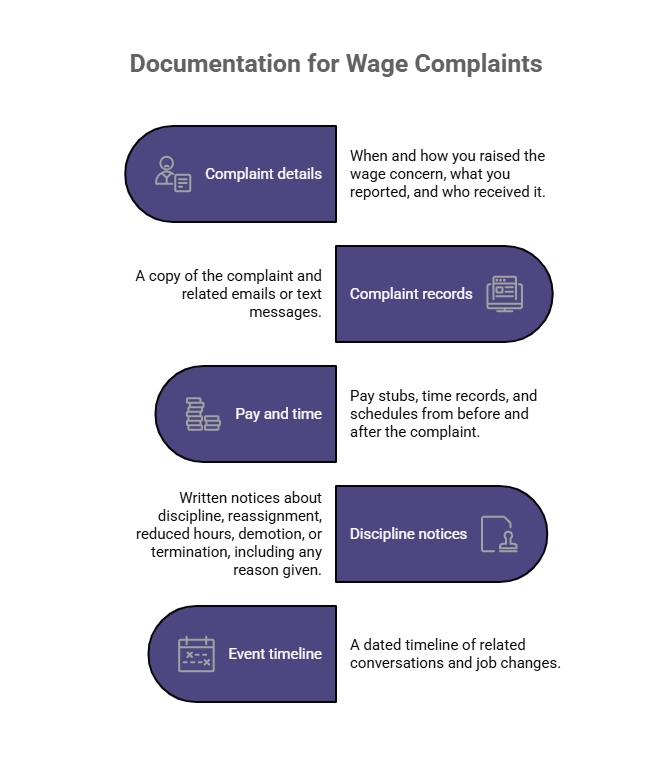
If your working conditions change after a wage complaint, keep your own records, including:
- When and how you raised the wage concern, what you reported, and who received it.
- A copy of the complaint and related emails or text messages.
- Pay stubs, time records, and schedules from before and after the complaint.
- Written notices about discipline, reassignment, reduced hours, demotion, or termination, including any reason given.
- A dated timeline of related conversations and job changes.
These records can help a New Jersey employment attorney compare the wage complaint, the job change, and the employer’s stated reason. Individualized legal review can then assess whether the wage-related anti-retaliation provisions may apply.
Zatuchni & Associates represents employees in employment matters throughout New Jersey. The firm’s service area includes Hackensack, Newark, Morristown, Jersey City, Flemington, Lambertville, Princeton, Trenton, Edison, New Brunswick, Woodbridge Township, Bridgewater Township, and Elizabeth. It also includes Bergen, Essex, Morris, Hudson, Hunterdon, Mercer, Middlesex, Somerset, and Union Counties.
General Information Notice
This material provides general information concerning New Jersey employment matters. It does not constitute individualized legal advice, and reading this material or contacting the firm through it does not, by itself, create an attorney-client relationship.
Employment disputes can involve significant factual, professional, and income-related considerations. Legal rights depend on specific circumstances, applicable law may change, and legal claims may be subject to strict and varying deadlines. A qualified New Jersey employment attorney can assess how current law may apply to an individual situation.
Concerned About Workplace Retaliation? Let’s Talk Through Your Options
Workplace retaliation can be stressful, confusing, and hard to face alone. Zatuchni & Associates helps employees in New Jersey understand whether an employer’s actions may qualify as unlawful retaliation and what options may be available.
If you are in Newark, Jersey City, Trenton, Princeton, Hackensack, Edison, New Brunswick, Elizabeth, or a nearby area, you are welcome to reach out for a Free Case Review.
Contact Us Today to speak with a workplace retaliation lawyer and take a calm, informed next step.
You can also connect with Zatuchni & Associates on Facebook or X.
You must be logged in to post a comment.