
📌 Key Takeaways
New Jersey warehouse workers may have a potential CEPA retaliation issue when a safety report is followed by a significant negative workplace change connected to that report.
- CEPA May Protect Safety Reports: CEPA may protect employees who report, object to, or refuse conduct they reasonably believe violates law or public policy.
- Four Elements Shape Claims: A worker generally must establish a reasonable belief, protected whistleblowing activity, an adverse employment action, and a causal connection.
- Termination Is Not Required: Reduced hours, substantially worse assignments, severe discipline, suspension, or termination may represent significant negative changes in working conditions.
- Timing Alone Is Insufficient: The sequence of events may be relevant, but management’s knowledge, decision-making, workplace records, and stated operational reasons also matter.
- Deadlines May Be Short: An OSHA Section 11(c) complaint generally carries a 30-day deadline, while a CEPA civil action generally carries a one-year deadline.
A workplace change after a safety report raises questions, but knowledge, causation, and documented facts may shape the legal outcome.
~ ~ ~ ~ ~ ~ ~ ~ ~ ~ ~ ~ ~ ~ ~ ~ ~ ~
A New Jersey warehouse worker who faces a significant negative change at work after raising a safety concern may have a potential retaliation issue. Key questions include what the employee raised, what management knew, what action followed, and whether the concern influenced the employer’s decision. Timing may be relevant, but it is only one part of the analysis.
The New Jersey Conscientious Employee Protection Act, commonly known as CEPA, prohibits certain forms of whistleblower retaliation under N.J.S.A. 34:19-3. Under certain circumstances, CEPA protects employees who report violations or provide testimony to a public body. It also protects workers who object to—or refuse to participate in—conduct they reasonably believe is illegal. It may also protect certain objections or refusals involving a clear mandate of public policy concerning public health, safety, welfare, or the environment. Whether CEPA applies depends on the specific facts.
What a Worker Generally Must Show Under CEPA
To establish a CEPA retaliation claim, an employee generally must show four things:
The employee reasonably believed the employer’s conduct violated a law, rule, or regulation or, where applicable, a clear mandate of public policy.
The employee engaged in whistleblowing activity protected by CEPA.
The employer took an adverse employment action against the employee.
A causal connection existed between the protected activity and the adverse employment action.
These elements require more than a workplace change occurring after a complaint. They focus on whether CEPA protected the employee’s conduct and whether that conduct was connected to the employer’s action. If an employee successfully proves their claim, remedies under CEPA may include reinstatement to their former position, recovery of lost wages, and compensation for other damages.
When Workplace Treatment Changes After a Safety Concern
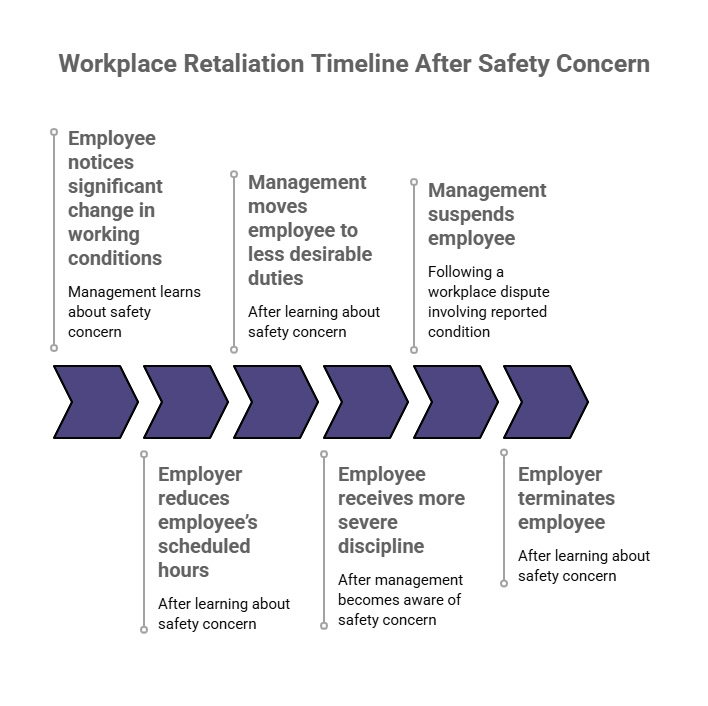
A warehouse employee may notice a significant change in working conditions after management learns about a safety concern. The change may affect scheduling, assignments, discipline, responsibilities, suspension, or employment status.
Examples may include, but are not limited to:
An employer significantly reduces an employee’s scheduled hours after learning about the employee’s safety concern.
Management moves an employee from a regular assignment to substantially less desirable duties.
An employee begins receiving more severe discipline after management becomes aware of the safety concern.
Management suspends an employee following a workplace dispute involving the reported condition.
An employer terminates an employee after learning about the safety concern.
Retaliation Can Take Forms Other Than Termination
An employee can remain employed while experiencing a material change in working conditions. A substantial reduction in scheduled hours may affect earnings, while a reassignment may significantly alter the employee’s regular responsibilities.
Employees experiencing these types of changes may encounter issues that overlap with broader New Jersey workplace retaliation matters.
Employers May Give Operational Reasons for Workplace Changes
Warehouse employers may identify workflow, staffing, shift coverage, assignments, productivity, or supervision as nonretaliatory reasons for a workplace change. Those explanations should be evaluated alongside what the employee reported, who knew about it, how the decision was made, and whether the stated reason is consistent with the available workplace records.
Warehouse Work Can Make Changes in Working Conditions Especially Noticeable
Warehouse operations commonly involve structured schedules, defined assignments, performance expectations, and direct supervision. Those features can make departures from an employee’s established working conditions readily apparent.
An employee who regularly performs one assignment, for example, may immediately recognize a substantial reassignment. A worker with a relatively consistent schedule may likewise notice a significant reduction in regularly scheduled hours.
Illustrative Example: A Warehouse Assignment Changes After a Safety Objection
An employee at an Edison distribution facility raises a concern with management about a condition that the employee believes creates a serious workplace-safety problem. Soon afterward, management removes the employee from a regular assignment and places the employee in a worse role or gives them less desirable duties.
The employee believes the earlier safety objection may have influenced the reassignment, while management attributes the change to operational needs.
The reassignment, management’s knowledge of the safety concern, and the employer’s stated operational reason would all be relevant to whether CEPA protected the employee’s conduct and whether that conduct was connected to the reassignment. The facts do not predetermine the legal outcome.
Steps a Worker Can Consider After Suspected Retaliation
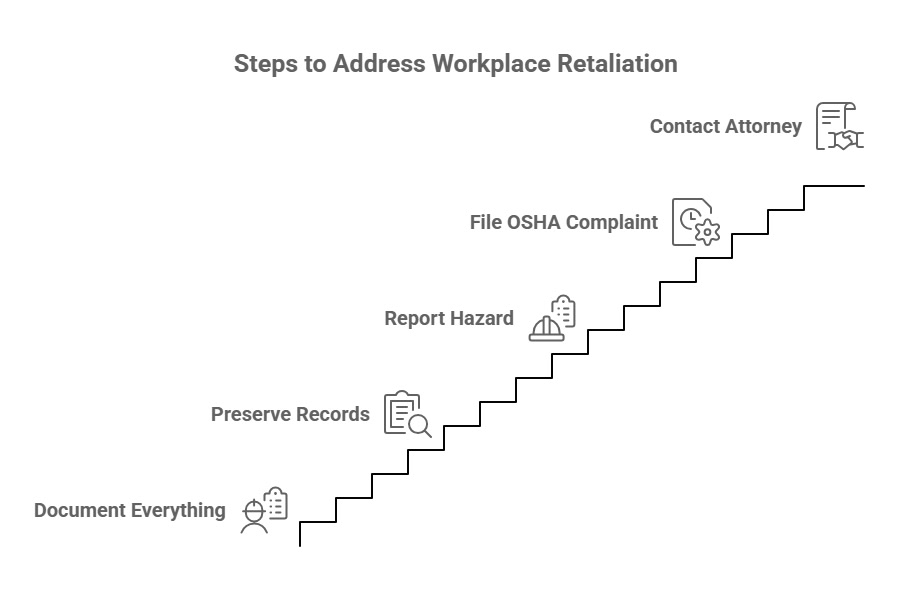
A worker who suspects retaliation may consider the following steps:
Write down the dates, people involved, how the safety concern was raised, management’s response, and each later change in hours, assignments, discipline, pay, or employment status.
Preserve lawfully accessible schedules, pay records, emails, text messages, written complaints, disciplinary notices, and names of potential witnesses. Workers should not alter records or take documents they are not authorized to possess.
Report an ongoing hazard promptly. Private-sector warehouse workers in New Jersey may file a safety and health complaint with federal OSHA, while state and local government workers are generally covered by New Jersey PEOSH.
Consider a separate OSHA whistleblower complaint if the retaliation involved activity protected by the federal Occupational Safety and Health Act. A Section 11(c) complaint generally must be filed within 30 days after the worker is notified of the retaliatory action.
Contact a New Jersey employment attorney promptly about possible New Jersey whistleblower representation. A CEPA civil action generally must be filed within one year of the alleged violation under N.J.S.A. 34:19-5, and other claims may have different deadlines.
Concerned About Workplace Retaliation? Let’s Talk Through Your Options
Workplace retaliation can be stressful, confusing, and hard to face alone. Zatuchni & Associates helps employees in New Jersey understand whether an employer’s actions may qualify as unlawful retaliation and what options may be available.
If you are in Newark, Jersey City, Trenton, Princeton, Hackensack, Edison, New Brunswick, Elizabeth, or a nearby area, you are welcome to reach out for a Free Case Review.
Contact Us Today to speak with a workplace retaliation lawyer and take a calm, informed next step.
You can also connect with Zatuchni & Associates on Facebook or X.
This material provides general information only. It does not constitute individualized legal advice or create an attorney-client relationship. Employment laws and their interpretation may change, and legal claims may be subject to deadlines that vary. An employment attorney can address legal and timing questions based on particular circumstances.
You must be logged in to post a comment.