
Article at a Glance
Sexual harassment claims are time-sensitive because the legal deadlines governing these claims may limit how long an employee has to take action. Early consultation with a New Jersey sexual harassment lawyer provides an opportunity for an individualized assessment of the alleged harassment, the employee’s working conditions, and any related employment consequences.
Employees may find these concerns particularly difficult when the alleged harasser is a supervisor who influences their compensation, promotions, work assignments, or continued employment. Fear of retaliation, reduced income, or termination may add to the uncertainty surrounding an already sensitive workplace situation.
Why Timing Matters in New Jersey Sexual Harassment Claims
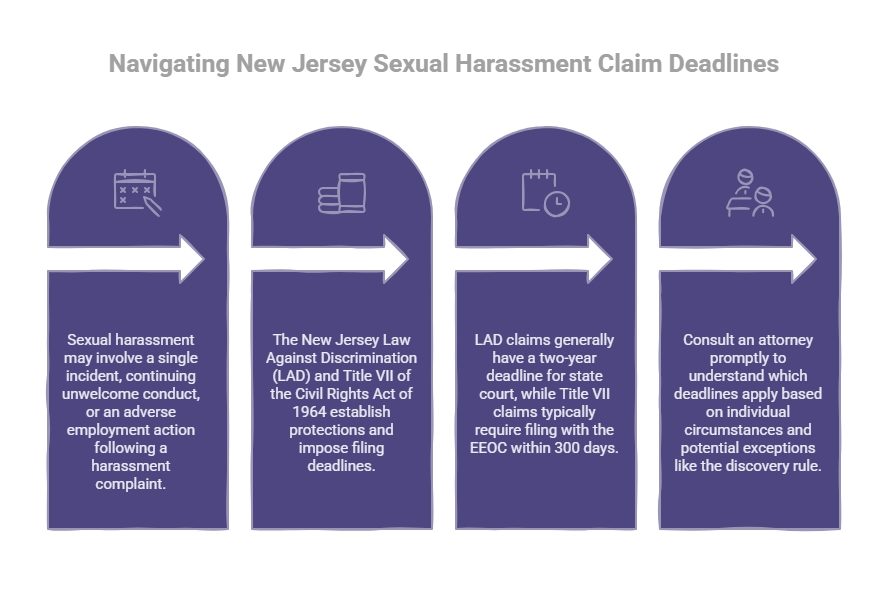
Sexual harassment may involve a single incident, continuing unwelcome conduct, or an adverse employment action following a harassment complaint. Each situation may affect the deadlines and legal options available to the employee.
The New Jersey Law Against Discrimination (LAD) prohibits sexual harassment as a form of sex discrimination. Title VII of the Civil Rights Act of 1964 also establishes federal protections against sexual harassment in the workplace.
Both the LAD and Title VII impose filing deadlines, and those deadlines differ depending on the law, the type of claim, and the forum in which an employee pursues relief. Under the LAD, employees generally have two years from the date of the alleged harassment to file a lawsuit in state court. Federal claims under Title VII require an employee to first file a charge with the Equal Employment Opportunity Commission (EEOC), typically within 300 days of the alleged conduct. Additional requirements and different deadlines apply when an employee files a complaint with the New Jersey Division on Civil Rights (DCR). As legal timelines can be complex, you should consult an attorney promptly about any timing questions. Because exceptions such as the discovery rule and the continuing violation doctrine may affect these deadlines, the specific timeframe applicable to a particular employee’s situation depends on its individual circumstances. Consulting an attorney promptly is one of the most important steps an employee can take to understand which deadlines apply.
Why Quid Pro Quo Harassment and Hostile Work Environment Allegations Require Different Assessments
Sexual harassment may involve unwanted sexual advances, demands for sexual favors, unwelcome physical contact, or offensive sex-based conduct affecting an employee’s working conditions.
New Jersey employment law recognizes two principal categories of sexual harassment:
- Quid pro quo harassment may arise when a supervisor conditions an employment opportunity or employment consequence on an employee’s response to a sexual demand.
- Hostile work environment harassment may arise when unwelcome conduct based on sex is sufficiently severe or pervasive to create a hostile or abusive working environment.
Examples of conduct that may contribute to a hostile work environment claim include repeated offensive comments or jokes of a sexual nature, the display of sexually explicit materials in the workplace, or unwelcome physical contact. Whether specific conduct crosses the legal line depends on several factors, including the frequency, severity, and nature of the behavior.
The distinction between these categories matters because the circumstances relevant to each may differ. A single sexual demand or threat may be considered quid pro quo harassment. Hostile work environment claims require a fact-sensitive assessment of whether the conduct was sufficiently severe or pervasive to alter the conditions of employment.
An isolated offensive comment does not automatically establish an unlawful hostile work environment, although a single incident may satisfy the applicable standard if it is sufficiently severe.
Neither category establishes liability merely because an employee experienced uncomfortable or offensive workplace conduct.
Adverse Employment Actions Following a Harassment Complaint
An employee who reports sexual harassment may subsequently experience unfavorable treatment by an employer. Such treatment may involve termination, demotion, reduced working hours, disciplinary write-ups, reassignment, or denial of advancement.
The LAD separately prohibits unlawful retaliation against employees who engage in protected activity, including reporting harassment. For example, an employee may report unwelcome sexual advances by a supervisor and subsequently receive disciplinary write-ups or experience reduced working hours. The sequence of events may raise concerns about retaliation, but it does not independently establish that the employer acted unlawfully. An employer’s unfavorable decision is not necessarily retaliatory merely because it follows a harassment complaint.
Why an Employer’s Knowledge and Response May Matter
An employer’s knowledge of alleged harassment and its response may be relevant when an employee reports misconduct that continues or affects working conditions.
New Jersey law recognizes an employer’s duty to prevent and address unlawful harassment. The assessment of employer responsibility depends partly on the circumstances of the alleged conduct and the relationship between the parties involved.
Harassment allegations may concern supervisors, managers, coworkers, clients, or customers. Where the alleged harasser is a coworker or another individual without supervisory authority, the employer’s knowledge and its response may carry particular legal significance. For instance, if a coworker repeatedly makes explicit jokes but management takes prompt and effective corrective action after receiving a report, the employer may have fulfilled its legal responsibilities. However, if human resources fails to address the complaint and the offensive conduct continues, the employer could potentially face liability for allowing a hostile work environment to persist.
However, an employer is not legally liable simply because you are unhappy with how they handled your complaint.
The Value of an Individualized Assessment by a New Jersey Sexual Harassment Lawyer
A New Jersey sexual harassment lawyer can assess alleged workplace misconduct in relation to established state and federal employment protections. Unlike general online information, an attorney’s professional assessment can account for the specific circumstances of the employee’s experience.
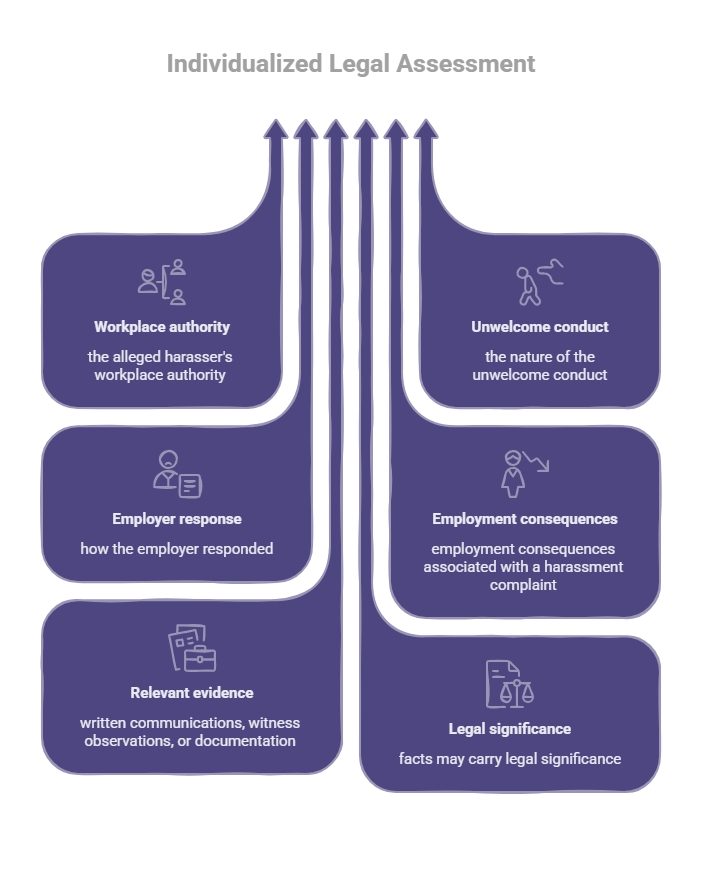
An individualized assessment may consider the alleged harasser’s workplace authority, the nature of the unwelcome conduct, how the employer responded, and any employment consequences associated with a harassment complaint.
Early consultation may also help an employee understand the importance of preserving relevant evidence, such as written communications, witness observations, or documentation of changes in employment conditions. An attorney familiar with New Jersey employment law can help identify which facts may carry legal significance and which steps may help protect an employee’s interests while a claim is still developing.
Consulting an attorney does not itself establish an actionable claim, require litigation, or guarantee any particular outcome.
Concerned About Sexual Harassment at Work? Let’s Talk Through Your Options
Unwanted workplace conduct can be upsetting, confusing, and difficult to address alone. Zatuchni & Associates helps employees in New Jersey understand whether certain behavior may qualify as unlawful sexual harassment and what options may be available.
If you are in Newark, Jersey City, Trenton, Princeton, Hackensack, Edison, New Brunswick, Elizabeth, or nearby areas, you are welcome to reach out for a Free Case Review.
Contact Us Today to speak with a sexual harassment lawyer and take a calm, informed next step.
You can also connect with Zatuchni & Associates on Facebook or X.
Related resources from Zatuchni & Associates:
- NJLAD Statute of Limitations: When to File Your Employment Claim
- Discriminated or Retaliated Against at Work? What to Do
- Human Resources: Do’s and Don’ts of Reporting Discrimination or Unlawful Harassment
Disclaimer: This article provides general information only and does not constitute individualized legal advice. Reading this material does not establish an attorney-client relationship. Employment laws and applicable legal requirements may change. An attorney’s evaluation of a particular workplace sexual harassment matter depends on its individual circumstances.
You must be logged in to post a comment.