
Article at a Glance
Workplace sexual harassment can cause significant personal harm even when an employee continues earning the same wages. Humiliation, anxiety, and apprehension may affect an employee’s daily working life without producing an immediate financial loss. Under the New Jersey Law Against Discrimination (NJLAD), emotional distress and other non-economic harm may be legally relevant when unlawful workplace sexual harassment has occurred.
The Consequences of Workplace Sexual Harassment May Extend Beyond Lost Wages
In workplaces where employees regularly interact with coworkers and supervisors, the effects of repeated unwelcome sexual conduct may shape day-to-day experiences in ways that do not appear on a pay stub.
An employee who previously felt at ease working alongside colleagues may become apprehensive about encountering a coworker responsible for unwelcome conduct.
Continued attendance and satisfactory job performance do not necessarily reveal whether an employee has experienced emotional distress.
Understanding the Personal Harm Associated With Workplace Sexual Harassment
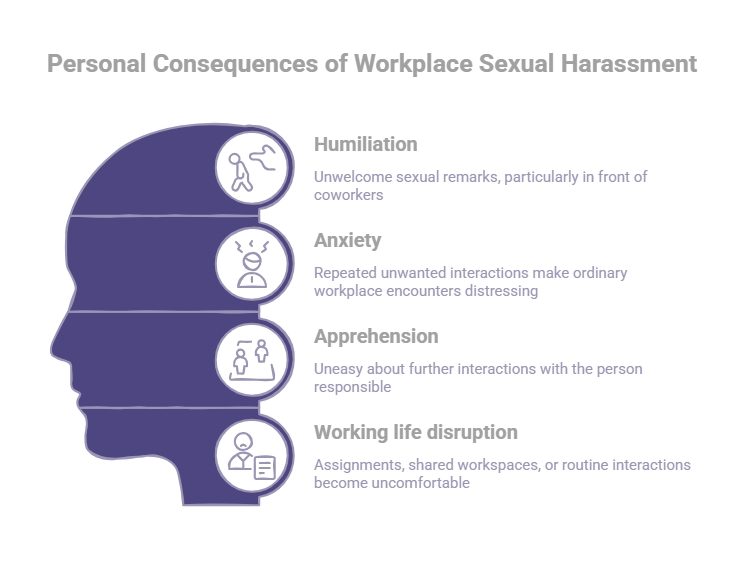
The personal consequences of alleged workplace sexual harassment vary according to the conduct involved and the employee’s circumstances. Unwelcome sexual comments, advances, or other sex-based misconduct may affect employees differently.
Possible consequences include:
- Humiliation often occurs when an employee endures unwelcome sexual remarks, particularly in front of coworkers.
- Anxiety can build when repeated unwanted interactions make ordinary workplace encounters distressing.
- Apprehension often sets in when an employee feels uneasy about further interactions with the person responsible for the alleged misconduct.
- Disruption to working life may result when familiar assignments, shared workspaces, or routine interactions become uncomfortable.
These experiences are illustrative rather than exhaustive. No particular emotional response can be presumed from the nature of an incident alone.
Personal distress may also remain largely invisible to others. An employee might continue fulfilling workplace responsibilities without openly expressing discomfort, even when everyday interactions have become upsetting.
Why Non-Economic Harm May Be Relevant Under New Jersey Employment Law
The New Jersey Law Against Discrimination, N.J.S.A. 10:5-1 et seq., prohibits sex-based discrimination, including unlawful sexual harassment in employment.
Two established legal concepts describe workplace sexual harassment.
Quid pro quo sexual harassment generally occurs when an employer or supervisor conditions job-related decisions — such as hiring, promotion, or continued employment — on an employee’s submission to sexual demands.
Hostile work environment sexual harassment concerns unwelcome sex-based conduct that meets the applicable legal standard, including the requirement that the conduct be severe or pervasive.
When an employee establishes unlawful workplace sexual harassment, compensatory damages may be available for resulting non-economic harm, including emotional distress, humiliation, and indignity. Unlike certain federal employment statutes that limit compensatory damages based on employer size, the NJLAD does not impose a statutory cap on emotional distress damages. This distinction may be significant when evaluating the potential scope of available remedies. The NJLAD also contains a fee-shifting provision, which may allow a prevailing employee to recover reasonable attorneys’ fees and litigation costs from the employer.
Non-economic harm differs from lost wages because it does not necessarily correspond to a measurable financial loss. Whether such harm supports compensatory damages depends on the circumstances, including the relationship between the unlawful conduct and the employee’s alleged injuries.
The New Jersey Division on Civil Rights identifies damages for pain and humiliation among the potential remedies for violations of the NJLAD.
The existence of emotional distress and the availability of compensatory damages involve distinct legal considerations. Recognition of an employee’s personal suffering does not, by itself, establish entitlement to compensation.
Evidence relevant to establishing non-economic harm may include testimony about the employee’s emotional state, documentation of changes in the employee’s workplace experience, and, in some circumstances, medical or psychological records. This might include personal journals kept contemporaneously, emails sent to human resources, testimony from friends regarding changes in the employee’s demeanor, or records from a therapist. The nature and extent of the evidence necessary will depend on the specific facts and the legal standards applicable to the claim.
Personal Distress Does Not, by Itself, Establish an Actionable Claim
An employee may experience genuine emotional distress without the alleged conduct necessarily constituting unlawful sexual harassment.
A hostile work environment assessment considers the nature of the alleged misconduct and the surrounding circumstances. The severe-or-pervasive standard concerns whether the conduct meets the applicable legal threshold. An employee’s subjective experience may be relevant, but it does not independently establish that the standard has been satisfied.
For example, an isolated offensive sexual remark may cause considerable embarrassment without necessarily creating an actionable hostile work environment. Whether such conduct constitutes unlawful sexual harassment depends on its nature and context.
Employer liability requires a separate assessment. Responsibility for alleged harassment may depend on the workplace roles of the individuals involved, their relationship to the employer, and other legally relevant circumstances.
These distinctions allow an employee’s experience to be acknowledged without assuming that the alleged misconduct establishes a legal violation or employer liability.
Illustrative Example: Personal Harm Without a Reduction in Pay
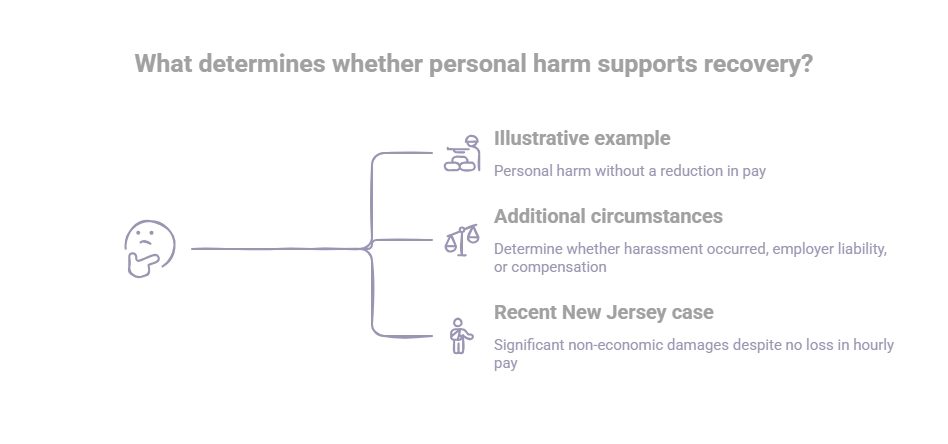
A New Jersey warehouse employee experiences repeated unwelcome sexual comments from a coworker during shared shifts. The employee begins avoiding certain break areas and feels apprehensive before each scheduled shift. Although the employee’s wages and job title remain unchanged, the workplace has become a source of daily distress rather than a neutral environment.
The example does not establish that unlawful harassment occurred, that the employer is liable, or that compensation is available. Those determinations depend on additional circumstances not included in the illustration. In one recent New Jersey case, for example, an employee was able to recover significant non-economic damages after enduring pervasive comments that required her to change her daily work routes, despite experiencing no loss in her hourly pay.
Concerned About Sexual Harassment at Work? Let’s Talk Through Your Options
Unwanted workplace conduct can be upsetting, confusing, and difficult to address alone. Zatuchni & Associates helps employees in New Jersey understand whether certain behavior may qualify as unlawful sexual harassment and what options may be available.
If you are in Newark, Jersey City, Trenton, Princeton, Hackensack, Edison, New Brunswick, Elizabeth, or nearby areas, you are welcome to reach out for a Free Case Review.
Contact Us Today to speak with a sexual harassment lawyer and take a calm, informed next step.
You can also connect with Zatuchni & Associates on Facebook or X.
This article provides general information and is not legal advice. Reading it does not create an attorney-client relationship. Laws may change. Strict deadlines apply to legal claims, and those deadlines vary. An attorney can address any time limits that may apply to an individual situation.
You must be logged in to post a comment.