
📌 Key Takeaways
Opposition Encompasses Informal Expression: Under the LAD, protected opposition extends beyond formal written complaints to include verbal objections, workplace discussions, and questions about practices reasonably believed to be discriminatory. The good-faith nature of the belief—rather than proof of actual violation—typically determines whether conduct qualifies as protected activity.
Retaliation Extends Beyond Termination: Materially adverse actions in the retaliation context may include reassignments, altered evaluation criteria, changed responsibilities, or exclusion from opportunities. The legal framework examines whether actions might dissuade reasonable individuals from voicing discrimination concerns.
Causal Connection Analysis Involves Multiple Factors: The LAD addresses whether temporal proximity, shifting explanations, or circumstantial evidence suggests that opposition motivated subsequent employment decisions. Establishing this causal nexus involves analyzing various factors within specific workplace contexts.
Early Legal Consultation Addresses Timing and Strategy: Contacting employment law attorneys in New Jersey early allows individuals to understand jurisdiction-specific options before making decisions that may affect legal rights, as timing considerations and confidentiality dynamics can be complex in retaliation matters.
This overview provides conceptual understanding of how opposition functions within New Jersey’s anti-retaliation framework, though specific applications depend on individual circumstances and current law. This content is for informational purposes only and does not constitute legal advice. Consultation with a qualified employment law attorney in New Jersey is necessary for advice specific to individual situations.
New Jersey workplaces operate under specific anti-discrimination protections that address what happens when employees voice concerns about race-based treatment. The concept of “opposing discrimination” carries distinct legal meaning under state law, particularly within the framework established by the New Jersey Law Against Discrimination (LAD), N.J.S.A. 10:5-1 et seq.
This overview examines what opposition may encompass under New Jersey protections, focusing on conceptual understanding rather than procedural guidance. Consulting with a qualified employment law attorney in New Jersey addresses jurisdiction-specific questions and individual circumstances that general information cannot address, as legal advice depends on the specific facts and nuances of each situation.
Opposition as protected activity generally refers to conduct that challenges practices an individual reasonably believes violate anti-discrimination protections. The LAD’s anti-retaliation provisions recognize opposition as a category distinct from formal participation in legal proceedings or investigations. Understanding this distinction may matter for professionals navigating workplace dynamics while considering their potential rights under state law.
Current information about LAD protections and filing procedures is available through the New Jersey Division on Civil Rights and the Equal Employment Opportunity Commission (EEOC), though laws are subject to change and professional legal counsel can explain how current law applies to specific circumstances.
This article provides general, informational context about workplace anti-discrimination concepts in New Jersey. It is not legal advice, does not create an attorney-client relationship, and may not reflect the most current legal developments.
Understanding “Opposing Discrimination” in New Jersey
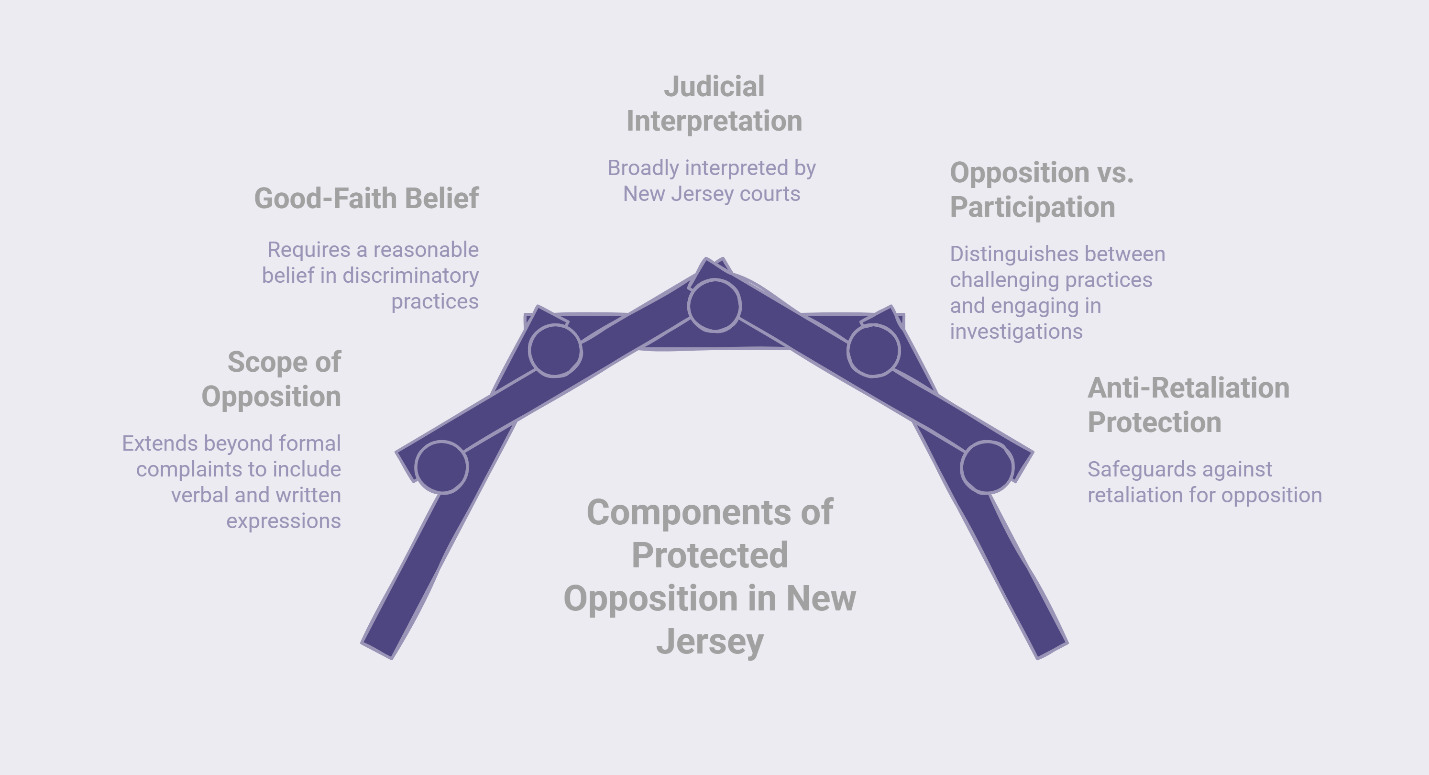
Protected opposition under the LAD encompasses conduct that expresses disagreement with practices perceived as discriminatory. The LAD’s opposition clause protects individuals who object to employment practices they reasonably believe violate the Act’s prohibitions, including those related to race discrimination. This protection operates independently of whether the opposed practice ultimately constitutes a statutory violation.
The scope of opposition extends beyond formal complaints to encompass various expressions of disagreement, including but not limited to verbal objections, written communications, and participation in workplace discussions about potentially discriminatory practices. The law recognizes that opposition can occur through informal channels, not solely through structured grievance procedures.
New Jersey judges or juries (as triers of fact) have generally interpreted opposition broadly, acknowledging that employees may express concerns through different means. The good-faith nature of the opposition—meaning the individual held a reasonable belief that discrimination occurred—may carry significance in determining whether conduct qualifies as protected activity. Documented patterns from the New Jersey Division on Civil Rights indicate that professionals of color in corporate environments raise concerns about race-related workplace treatment across various industries.
The distinction between opposition and participation matters under the LAD’s structure. Opposition involves challenging practices believed to be discriminatory, while the participation clause refers to engaging in investigations, proceedings, or hearings related to discrimination claims. Both categories receive anti-retaliation protection, though they address different types of employee conduct.
+——————————————————————————————————-+
💡 Quick Takeaways
- Protected opposition scope: Conduct expressing disagreement with practices reasonably believed to violate anti-discrimination protections may qualify as protected activity under the LAD.
- Good-faith standard: The reasonableness of an individual’s belief that discrimination occurred, rather than proof of actual violation, typically determines opposition protection.
- Distinction from participation: Opposition involves objecting to discriminatory practices, while participation refers to engaging in formal investigations or proceedings.
+——————————————————————————————————-+
Illustrative, Non-Obvious Examples of “Opposition”
Hypothetical scenarios demonstrate how opposition concepts may apply in New Jersey workplaces. An employee who questions a manager’s stated preference for candidates from specific racial backgrounds during hiring discussions might engage in protected opposition. The outcome could depend on factors including how the concern was expressed and whether the employee held a reasonable belief that discriminatory criteria were being applied.
This hypothetical is for educational context only and does not constitute legal advice. Outcomes vary by facts and jurisdiction.
In another scenario, an employee who objects to performance evaluation criteria that appear to disproportionately disadvantage colleagues of a particular race may be engaging in opposition. Whether such conduct receives protection might depend on the reasonableness of the belief underlying the objection and the manner of expression.
This hypothetical is for educational context only and does not constitute legal advice. Outcomes vary by facts and jurisdiction.
Consider a situation where an employee raises concerns about racially charged remarks made during team meetings. Such conduct could constitute protected opposition if the employee reasonably believed the remarks contributed to a hostile work environment. Multiple factors, including the context and the employee’s understanding of anti-discrimination protections, might influence whether the conduct qualifies as protected activity.
This hypothetical is for educational context only and does not constitute legal advice. Outcomes vary by facts and jurisdiction.
A professional who advocates for review of promotion processes after observing patterns that suggest racial disparities might engage in opposition. The legal analysis would likely examine whether the individual held a good-faith belief that discriminatory practices existed and how that advocacy was communicated.
This hypothetical is for educational context only and does not constitute legal advice. Outcomes vary by facts and jurisdiction.
+——————————————————————————————————-+
💡 Quick Takeaways
- Informal expressions: Opposition can include verbal objections, questions about criteria, and advocacy for process reviews when based on good-faith beliefs about discrimination.
- Context matters: The reasonableness of the underlying belief and manner of expression may influence whether conduct qualifies as protected opposition.
+——————————————————————————————————-+
How “Opposition” Relates to Retaliation Concepts
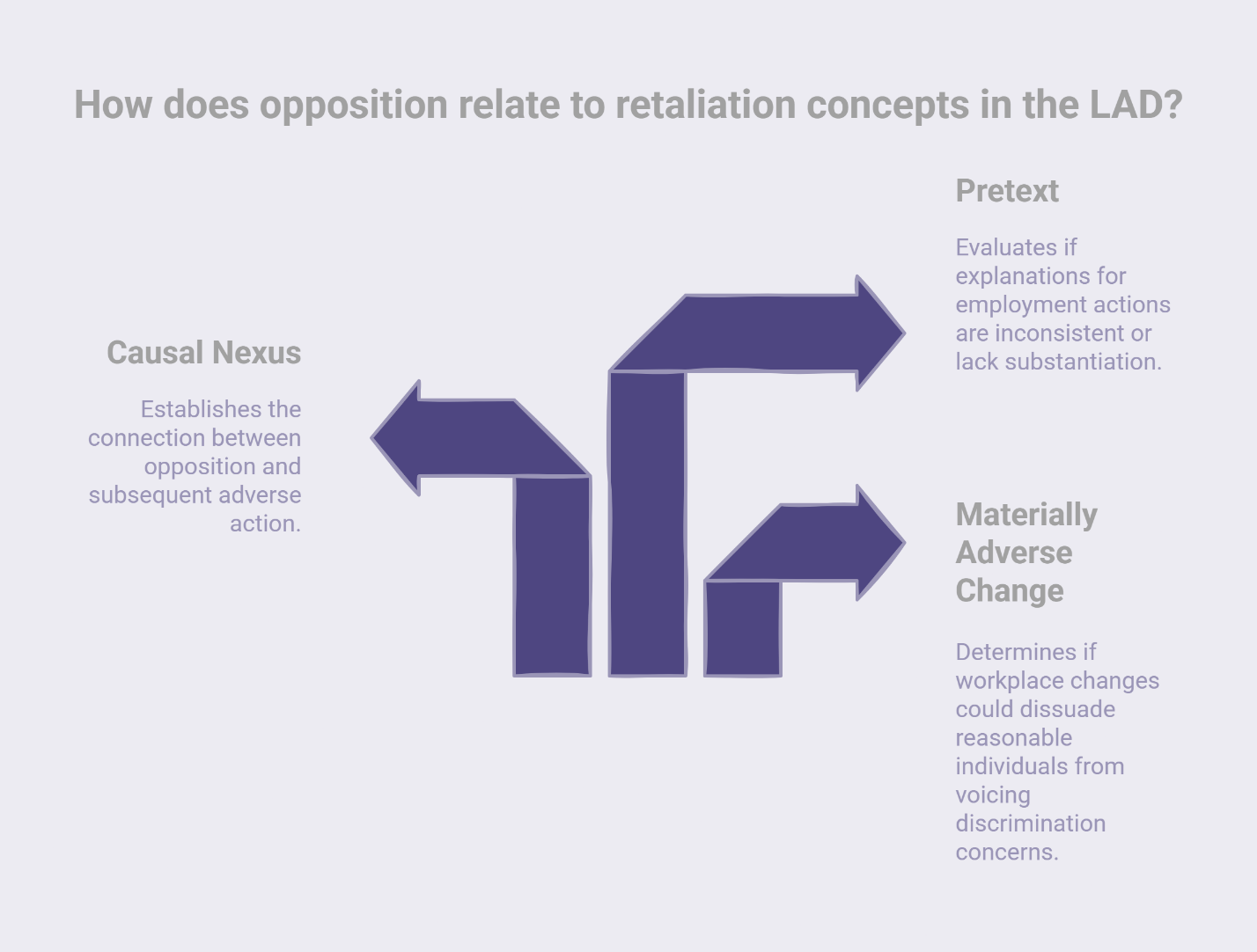
Anti-retaliation protections under the LAD may operate when adverse employment actions follow protected opposition. The concept of materially adverse change encompasses employment decisions or conditions that might dissuade reasonable individuals from voicing discrimination concerns. This standard extends beyond ultimate employment decisions like termination to include various workplace changes.
Adverse employment actions in the retaliation context may include, but are not limited to, reassignments, changes in responsibilities, altered evaluation criteria, or exclusion from opportunities. The trier of fact in New Jersey proceedings evaluates whether actions taken after opposition could be materially adverse in the context of the specific workplace and role.
Causal nexus refers to the connection between protected opposition and subsequent adverse action. The LAD addresses whether temporal proximity, shifting explanations, or other circumstantial evidence suggests that opposition motivated the adverse action. Employers and managers make numerous employment decisions; establishing that opposition played a role in specific decisions involves analyzing various factors.
The concept of pretext may arise when explanations for employment actions following opposition appear inconsistent or lack substantiation. From organizational perspectives, legitimate business reasons for employment decisions exist independently of employee opposition. From employee perspectives, the timing and context of actions following opposition may raise questions about motivation. Legal counsel can analyze how these concepts apply to particular fact patterns, as the interaction between opposition, timing, and employment decisions varies significantly across situations.
+——————————————————————————————————-+
💡 Quick Takeaways
- Materially adverse standard: Actions that might dissuade reasonable individuals from voicing concerns can constitute adverse employment actions in retaliation analysis.
- Causal connection analysis: The LAD examines whether evidence suggests opposition motivated subsequent employment decisions through factors including timing and consistency.
+——————————————————————————————————-+
Timing and Confidentiality Awareness
Timing considerations exist in employment law matters, though specific procedural timelines fall outside this overview’s scope. Individuals considering whether to voice workplace concerns often weigh confidentiality implications alongside professional consequences. These concerns reflect the practical realities that professionals face when encountering situations they believe involve discriminatory treatment.
Confidentiality dynamics in workplace settings can be complex. Communications about discrimination concerns may involve various parties, including but not limited to managers, human resources personnel, and colleagues. The expectation of confidentiality may vary depending on context, organizational policies, and the nature of the communication.
Contacting a qualified employment law attorney in New Jersey early in the process allows individuals to understand their specific options before making decisions that may affect their legal rights. Professional legal counsel addresses how the LAD applies to particular circumstances, including timing factors and confidentiality questions that arise in specific workplace contexts.
Organizations and employees both have legitimate interests in how discrimination concerns are raised and addressed. From organizational perspectives, understanding and responding to concerns appropriately serves various functions. From employee perspectives, knowing that protections exist for good-faith opposition may inform decisions about whether and how to voice concerns.
The Conscientious Employee Protection Act (CEPA), N.J.S.A. 34:19-1 et seq., provides adjacent protections for whistleblowing activity that may overlap with LAD opposition in certain contexts. Where conduct involves both opposing discrimination and reporting violations of law, policy, or regulation, multiple protection frameworks might apply.
Conclusion
Protected opposition under the LAD encompasses various forms of conduct through which individuals express disagreement with practices they reasonably believe violate anti-discrimination protections. The LAD’s opposition clause provides a framework distinct from participation in formal proceedings, recognizing that concerns about discriminatory treatment may be voiced through multiple channels.
Understanding what may constitute opposition, how it relates to retaliation concepts, and why timing and confidentiality may be relevant can inform individuals facing workplace situations involving potential race discrimination. Consulting with qualified employment law attorneys in New Jersey can help proactively address individual circumstances and legal options before situations escalate or rights may be affected.
This article provides general, informational context about workplace anti-discrimination concepts in New Jersey. It is not legal advice, does not create an attorney-client relationship, and may not reflect the most current legal developments.
Frequently Asked Questions
What does “protected activity” generally include?
Protected activity under the LAD typically includes both opposition to practices reasonably believed to violate anti-discrimination protections and participation in investigations or proceedings related to discrimination claims. Opposition encompasses expressing disagreement with discriminatory practices through various means, while participation involves engaging with formal processes. Both categories receive anti-retaliation protection, though they address different types of employee conduct and may apply different standards.
Can workplace pushback after an objection be considered retaliation?
Workplace responses following an objection may constitute retaliation if they involve materially adverse actions causally connected to protected opposition. The LAD examines whether the actions taken might dissuade reasonable individuals from voicing discrimination concerns and whether evidence suggests opposition motivated those actions. Not all negative workplace experiences following opposition constitute retaliation; the legal framework analyzes specific factors including, but not limited to, timing, the nature of the action, and evidence of causal connection.
Frequently Unasked Questions
Can informal, verbal objections ever qualify as “opposition”?
Informal verbal objections can qualify as protected opposition under the LAD when they express disagreement with practices the individual reasonably believes violate anti-discrimination protections. The LAD’s opposition clause does not require formal written complaints or adherence to specific procedures. The good-faith nature of the belief underlying the objection and the context in which concerns were expressed may be relevant to whether informal communications constitute protected activity.
Is “opposition” limited to written or formal complaints?
Opposition under the LAD extends beyond written or formal complaints to encompass various forms of expressing disagreement with perceived discriminatory practices. While written communications may provide clearer documentation, the statute recognizes that employees voice concerns through different channels. The scope of protected opposition reflects an understanding that individuals may object to discrimination in various workplace contexts, not solely through structured grievance processes or formal documentation.
This article provides general, informational context about workplace anti-discrimination concepts in New Jersey. It is not legal advice, does not create an attorney-client relationship, and may not reflect the most current legal developments.
Empower Your Voice — We’re Here to Help
At Zatuchni & Associates, we’ve spent over two decades standing up for New Jersey employees who’ve faced race-based discrimination and retaliation. If you believe your rights under the New Jersey Law Against Discrimination (LAD) may have been violated, understanding your legal options early can make all the difference.
Whether you’ve raised concerns informally or are unsure if your experience qualifies as protected opposition, our experienced race discrimination attorneys are here to listen, evaluate, and guide you—confidentially and without pressure. Contact us today to schedule a private consultation with a dedicated employment lawyer.
You must be logged in to post a comment.