
📌 Key Takeaways
- Practical Delays Can Make Workplace Experiences Harder to Explain Later:
Waiting a long time to discuss race-related concerns can make it more difficult to recall who said what, when events occurred, and how supervisors or colleagues responded. Changing email systems, messaging platforms, and organizational structures can also mean that useful records and witnesses are no longer available when someone tries to describe what happened. - Race Discrimination and Retaliation Concerns Often Develop as Patterns Over Time:
Many professionals of color in New Jersey experience a series of subtle shifts—such as changes in assignments, tone, feedback, or inclusion in key meetings—rather than a single dramatic event. The longer these patterns go unaddressed, the more challenging it can become to reconstruct the sequence in a way that others can understand. - Clear Chronology Typically Helps New Jersey Race Discrimination Lawyers Understand Situations:
Race discrimination lawyers often focus on the order in which race-related comments, internal complaints, performance reviews, and any adverse employment actions occurred. Conversations may be more productive when events are still relatively recent and workplace records are easier to locate and review. - Confidential Support and Jurisdiction-Specific Legal Advice May Be Valuable:
Individuals experiencing serious or ongoing race-related concerns frequently seek both confidential legal consultations and non-legal support, such as employee assistance programs or community organizations. Because New Jersey law, including the New Jersey Law Against Discrimination, may change and depends on specific facts, a qualified New Jersey attorney is generally the appropriate resource for legal advice about any particular situation.
Reading the full content can provide a more detailed understanding of how practical timing, evolving workplace patterns, and confidentiality concerns interact when race-related issues arise in New Jersey workplaces. This summary and the related content are for informational purposes only, do not constitute legal advice, and should not replace consultation with a qualified New Jersey attorney about individual circumstances.
Practical timing around race-related workplace concerns in New Jersey can strongly affect how those concerns are understood, documented, and later discussed with New Jersey race discrimination lawyers. Someone who has already typed ‘is this illegal or just unfair’ or ‘retaliation after complaint’ into a search bar may also worry that waiting to talk with anyone is making the situation harder to explain.
This informational overview focuses on real-world timing, not legal filing periods. It does not provide legal advice. Under New Jersey law, including the New Jersey Law Against Discrimination (NJLAD), race is generally treated as a protected characteristic in employment, but this summary does not describe legal tests or elements and may not reflect the most current legal developments. Individuals can review official New Jersey government and civil rights agency resources for current information and may wish to consult a qualified New Jersey attorney for advice about any particular situation.
Why Timing Around Race Discrimination Concerns Can Matter in New Jersey Workplaces
Race-related concerns at work often unfold over months or years. When a long time passes before anyone hears a detailed account, it can become noticeably harder to describe what happened in a clear, chronological way. Words that once felt unforgettable in a meeting can blend together with other comments, and recollections of who was present, which project was involved, or how a supervisor responded may become less precise.
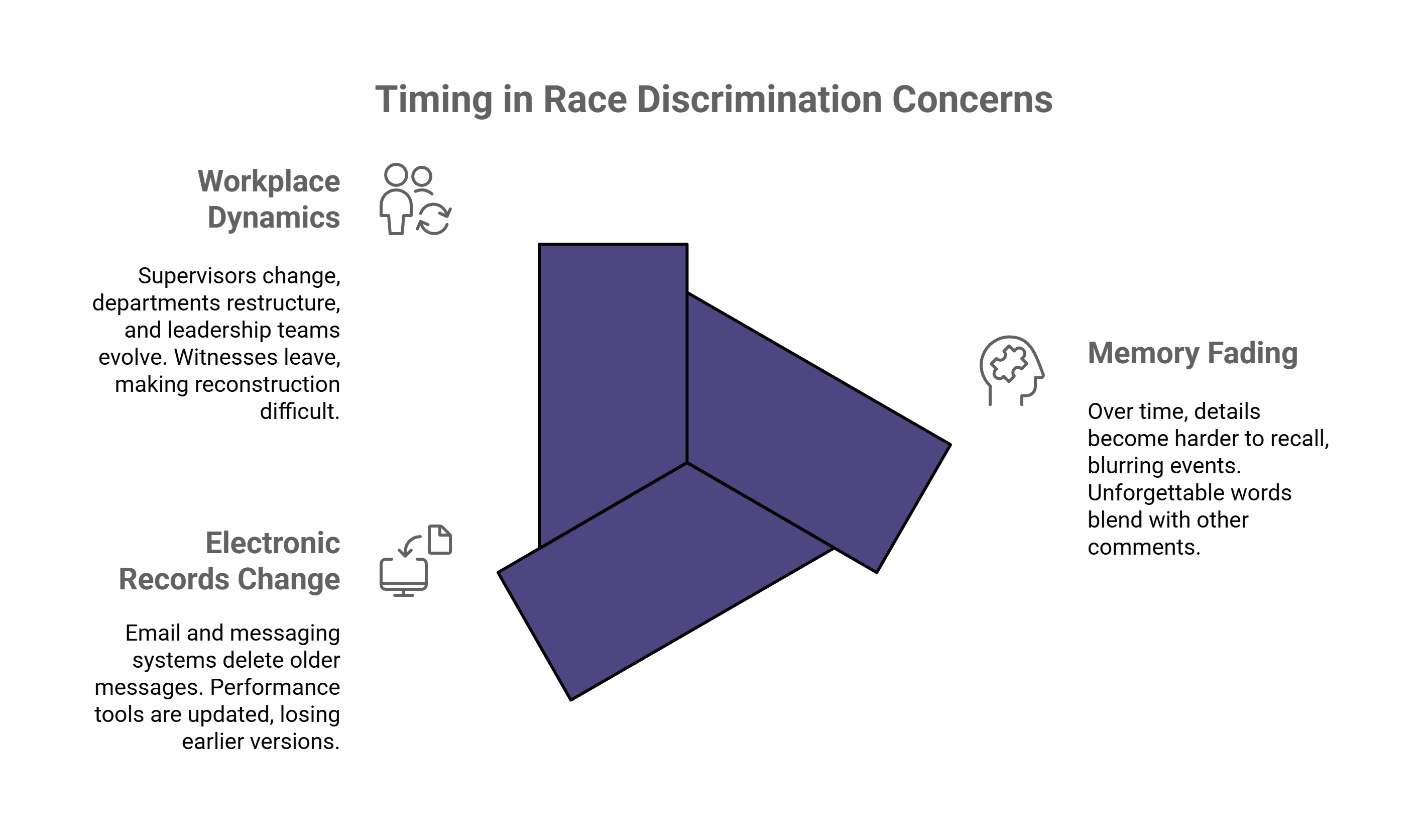
Electronic records also change. Email systems may delete older messages as part of routine maintenance. Messaging platforms may limit how far back conversations can be viewed. Performance management tools may be updated or replaced, which can make it difficult to see earlier versions of reviews or goals that seemed to shift after race-related concerns were raised.
New Jersey workplaces themselves are rarely static. Supervisors are promoted or transferred, departments are restructured, and leadership teams change. When people who witnessed key moments leave the organization, efforts to reconstruct who said what and when may depend heavily on memories that no longer align.
Race discrimination and retaliation concerns can involve complex factual and legal questions, so decisions about whether to delay or seek advice may carry significant professional and legal consequences that only an attorney can evaluate in context. One required general reminder also applies:
“Strict deadlines apply to legal claims, and these deadlines vary. You should speak with an attorney as soon as possible about any time limits that may apply to your situation.”
No further explanation of deadlines is provided here; all remaining timing discussion is purely practical.
How Workplace Events and Patterns Can Become Harder to Explain Over Time
Many New Jersey professionals of color describe not just one troubling incident, but a pattern that becomes apparent only over time. Comments about “fit,” subtle shifts in tone, and changes in assignments can accumulate slowly. When those developments are not discussed or documented for a long period, describing the pattern later can feel like trying to replay a series that has missing episodes.
[ILLUSTRATIVE EXAMPLE]
In a hypothetical New Jersey corporate environment, a mid-career employee of color reports repeated remarks about “professional style” that seem tied to race. Over the following year, the employee receives fewer high-visibility assignments, sees a noticeable change in performance review language, and is no longer invited to meetings where strategic decisions are made. If the employee waits a long time before explaining this sequence in detail, it may be difficult to recall the order of events, which comments came before the internal report, and how the review language shifted. Colleagues and managers may genuinely remember the same events differently.
[END EXAMPLE]

Patterns that may raise race discrimination or retaliation concerns in everyday workplace life can include, among other things:
- A distinct change in assignments or client exposure after someone raises race-related concerns or engages in protected activity, such as reporting those concerns to human resources.
- Shifts over time in feedback, tone, or scrutiny that appear connected to prior complaints about race-based treatment or a prior adverse employment action.
- Exclusion from meetings, mentoring opportunities, or informal networking channels that previously included the individual.
As months or years pass, calendar entries may disappear, messages may no longer be accessible, and key participants may move on. The result can be a situation where the core experience remains very real to the employee, while the ability to reconstruct the pattern in detail becomes more limited.
Why Many People Choose to Speak with New Jersey Race Discrimination Lawyers Sooner Rather Than Later
When individuals in New Jersey consult race discrimination lawyers, those attorneys often begin by asking what happened first, what changed next, and how the organization responded. A clear chronology helps the attorney understand how race-related comments, internal complaints, performance reviews, and any adverse employment action may relate to one another. That kind of timeline is usually easier to describe while events are still relatively recent and workplace records are more accessible.
An early conversation with a racial discrimination attorney can provide orientation about whether a series of experiences may have legal implications, without requiring the individual to commit to any particular path. These consultations are generally confidential, which can matter greatly to professionals who worry about being perceived as “difficult” or fear that raising race-related issues could affect their long-term career trajectory.
Emotional strain is another practical timing factor. Uncertainty about whether a situation is “illegal or just unfair” can weigh heavily over time. Some individuals find it helpful to seek non-legal support as well, such as an employee assistance program or community organizations that support workers of color who are experiencing discrimination concerns. Those resources do not replace legal advice, but they may help someone cope with stress while considering whether to contact an attorney.
Because race-based workplace concerns and possible retaliation can be complex and consequential, many individuals experiencing serious or ongoing issues in New Jersey choose not to wait indefinitely before contacting a New Jersey race discrimination attorney to discuss their circumstances in more detail.
Conclusion
Practical timing, distinct from formal legal deadlines, can strongly influence how clearly race-related workplace experiences in New Jersey can later be described, documented, and evaluated. Memories shift, electronic records change, and organizations reorganize, even while the impact on a person’s career and well-being may continue.
This overview is for informational purposes only and does not provide legal advice. Laws, including the New Jersey Law Against Discrimination, are subject to change and may be applied differently based on specific facts. Individuals who are dealing with serious or persistent race-related concerns in New Jersey workplaces often review official state resources and consult New Jersey race discrimination lawyers to obtain guidance tailored to their particular situation.
FAQs
Why might the timing of what happens at work matter when someone talks with a New Jersey race discrimination lawyer?
Race discrimination lawyers often review not only what happened, but when and in what order. They may look at when race-related comments occurred, when concerns were raised, how management responded, and whether later performance evaluations or assignment changes followed those events. That kind of sequence is generally easier to describe while details remain relatively fresh and workplace records are easier to locate. This answer is for general informational purposes only, is not legal advice, and laws may change.
Is it common for people to wait before talking with a lawyer about race discrimination concerns?
Many individuals hesitate before contacting an attorney about race discrimination or retaliation because they worry about confidentiality, office politics, or being seen as overly sensitive about race. Others hope that a new manager, a transfer, or time alone will resolve the situation. Over time, some find that uncertainty and ongoing stress become harder to manage and decide that a confidential conversation with a New Jersey race discrimination lawyer may help them understand their circumstances more clearly. This answer is for general informational purposes only, is not legal advice, and laws may change.
Frequently Unasked Questions
What can become more difficult if someone waits a long time to talk with someone about race-related problems at work?
As more time passes, specific details that once seemed obvious can become harder to reconstruct, and electronic records or calendar entries that might once have supported those recollections may no longer be available. People involved in earlier events may leave the organization or remember meetings differently, which can complicate later efforts to describe what happened in a consistent way. This answer is for general informational purposes only, is not legal advice, and laws may change.
Could social media posts about workplace problems affect how a situation is viewed later?
Public posts about workplace experiences can sometimes become part of how a situation is understood, because screenshots, forwards, or comments may circulate even after the original content is deleted. Employers, attorneys, or other decision-makers may review those posts when trying to understand the history of a dispute, and seemingly unrelated posts can occasionally shape how someone’s account is perceived. Individuals who have race-related concerns at work often raise questions about social media and online expression with an attorney so they can understand the potential implications in their specific circumstances. This answer is for general informational purposes only, is not legal advice, and laws may change.
Disclaimer: This content is for informational purposes only. This content is not legal advice. No attorney–client relationship is formed through this content. A qualified New Jersey attorney is the appropriate resource for legal advice specific to any particular situation.
Concerned About Timing Around Race-Related Workplace Issues? Get Clarity.
Race-related concerns in the workplace can be difficult to explain clearly as time passes. At Zatuchni & Associates, we assist New Jersey employees in assessing whether their experiences may involve race discrimination, retaliation, or other legal issues under state employment laws.
If you’re dealing with a situation that has developed over time—or you’re unsure whether delays in documentation may affect your options—a confidential consultation can help you understand the potential implications. Contact us today to speak with an experienced New Jersey race discrimination attorney.
You must be logged in to post a comment.