
📌 Key Takeaways
Federal Law Provides Two Distinct Protection Categories: Title VII establishes participation clause protections for formal EEOC involvement and opposition clause protections for opposing practices individuals reasonably believe constitute discrimination, with Section 1981 offering additional race-specific protections that may apply regardless of employer size.
Reasonable Belief Standard Governs Protection Eligibility: Federal courts generally apply an objective reasonableness standard, examining whether individuals held good faith beliefs that opposed practices violated federal anti-discrimination laws, without requiring employees to possess legal expertise for protection qualification.
Corporate Executives Face Complex Analysis Requirements: Protected activity determinations in New Jersey corporate environments involve nuanced factual analyses examining specific circumstances, individual knowledge of federal requirements, and expression methods, with professional standing and career implications creating unique considerations.
Professional Legal Consultation Proves Essential: Federal protected activity determinations require analysis by qualified employment attorneys due to complex interactions between Title VII and Section 1981, evolving court interpretations, and time-sensitive EEOC filing deadlines typically ranging from 180 to 300 days.
Jurisdictional Coverage Varies by Federal Statute: Title VII protections generally apply to employers with fifteen or more employees, while Section 1981 protections may apply regardless of employer size, creating comprehensive federal frameworks for race discrimination complaints in New Jersey’s pharmaceutical, finance, and technology sectors.
Understanding these federal protections requires comprehensive legal analysis considering individual circumstances, applicable precedent, and strategic timing. This content provides general information about federal employment law concepts and is not legal advice, recommending consultation with qualified employment attorneys for specific protected activity determinations.
Corporate executives who face potential workplace discrimination may find themselves in a challenging position of speaking up about discriminatory treatment while also seeking to protect their professional standing. Understanding federal protected activity definitions becomes crucial when navigating these complex situations.
Employment lawyers in New Jersey and other states frequently assist senior professionals who need clarity about when federal law may shield their workplace complaints from retaliation.
Federal employment law provides specific protections for certain types of workplace complaints and actions under Title VII of the Civil Rights Act of 1964 and Section 1981 of the Civil Rights Act of 1866. These statutes establish a framework that may protect individuals who engage in particular activities related to discrimination complaints.
Important Note: Employment laws are subject to change and federal court interpretation may vary by jurisdiction and case-specific facts.
Determining whether an action constitutes federally protected activity requires analysis by a qualified employment attorney.
Federal Protected Activity Framework Under Title VII
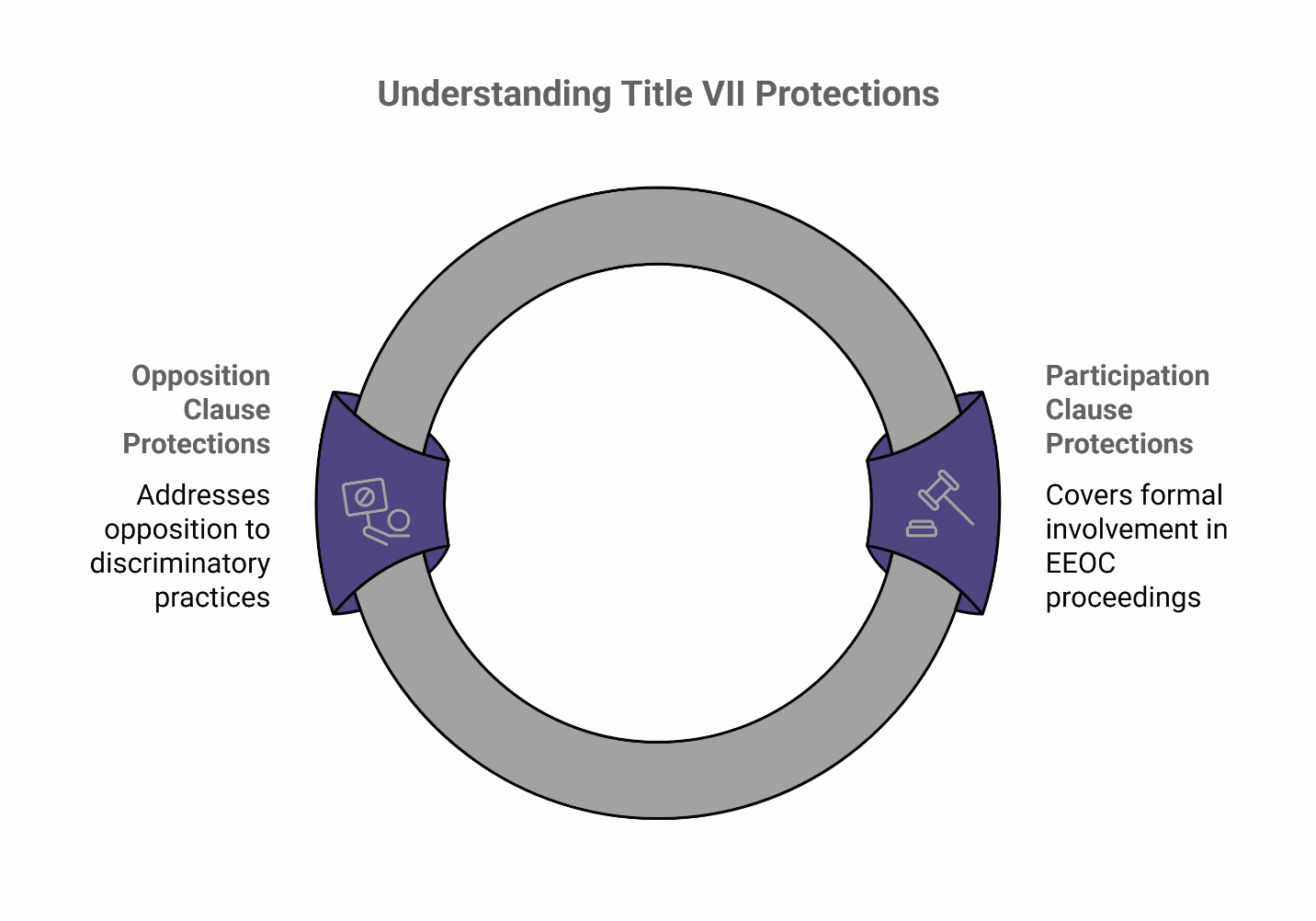
Under federal law generally, Title VII’s anti-retaliation provision, codified at 42 U.S.C. § 2000e-3(a), establishes two distinct categories of protected activity: participation clause protections and opposition clause protections. These federal protections may apply to employers with fifteen or more employees, encompassing most major corporations operating in New Jersey. Laws and regulations are subject to change.
Participation Clause Protections
Participation Clause Protections generally cover formal involvement in Equal Employment Opportunity Commission (EEOC) proceedings. This might include:
- Filing EEOC charges
- Providing testimony during investigations
- Assisting in formal complaint processes
Federal courts have generally interpreted participation clause protections broadly, recognizing that the formal complaint process requires comprehensive protection to function effectively.
Opposition Clause Protections
Opposition Clause Protections typically address situations where individuals oppose practices they reasonably believe constitute employment discrimination. The Supreme Court’s decision in Crawford v. Metropolitan Government established that opposition clause protections may extend beyond active complaints to include situations where employees respond to internal investigations about discriminatory conduct.
[ILLUSTRATIVE EXAMPLE]
Consider a hypothetical scenario involving a senior pharmaceutical executive who witnesses racially discriminatory hiring practices during management meetings. When the executive expresses concerns about these practices to human resources, federal opposition clause protections might apply.
The analysis would focus on whether the executive held a reasonable belief that the witnessed conduct violated federal anti-discrimination laws. This example illustrates legal concepts only, and individual circumstances require professional legal analysis.
[END EXAMPLE]
Federal courts typically evaluate opposition clause claims using a reasonableness standard, which examines whether the individual held a good faith, reasonable belief that the opposed practice violated federal employment discrimination laws. The standard acknowledges that an employee is not required to be a legal expert to qualify for protection.
Complex workplace situations involving potential protected activity should be evaluated by experienced employment counsel, as federal court interpretations can vary and individual circumstances significantly affect the legal analysis.
+——————————————————————————————————-+
💡 Quick Takeaways
- Federal Framework: Title VII may establish participation and opposition clause protections for discrimination-related activities.
- Reasonable Belief Standard: Opposition clause protections might apply when individuals reasonably believe practices violate federal law.
- Corporate Coverage: Federal protections generally apply to employers with fifteen or more employees.
+——————————————————————————————————-+
Section 1981 Anti-Retaliation Protections

Under federal law generally, Section 1981, codified at 42 U.S.C. § 1981, may provide additional federal protections against retaliation for race-related discrimination complaints. This statute offers broader employer coverage than Title VII, as it may apply regardless of employer size.
For corporate executives in New Jersey’s diverse business environment, Section 1981 protections might prove particularly relevant. Federal statutes are subject to judicial interpretation and legislative changes.
Scope of Section 1981 Protections
Federal courts have recognized that Section 1981 protections may extend to both formal and informal complaints about race-based discrimination. The statute’s broad language encompasses situations where individuals oppose racial discrimination in various employment contexts, from hiring and promotion decisions to workplace harassment.
The interaction between Title VII and Section 1981 protections creates a comprehensive federal framework. While Title VII addresses multiple protected characteristics, Section 1981 focuses specifically on race-based discrimination. This dual protection system means that race-related complaints might qualify for federal protection under either or both statutes.
[ILLUSTRATIVE EXAMPLE]
In a hypothetical situation involving a technology company executive who questions racially discriminatory performance evaluation practices, both Title VII and Section 1981 protections might apply.
The executive’s concerns about race-based evaluation disparities could potentially qualify as protected opposition activity under federal law, provided the reasonable belief standard is satisfied. This simplified example illustrates legal concepts only and does not constitute legal advice.
[END EXAMPLE]
Federal circuit courts have generally interpreted Section 1981’s anti-retaliation provisions consistently with Title VII’s framework, often applying similar reasonableness standards for opposition clause protections. However, jurisdictional variations exist, and specific applications may differ based on circuit court interpretations.
Protected activity determinations involve nuanced legal analyses that require consultation with a qualified attorney specializing in employment discrimination law.
Federal Law Application in New Jersey Corporate Environments
New Jersey’s diverse corporate landscape includes numerous employers subject to federal anti-discrimination statutes. Pharmaceutical, financial services, and technology companies operating in the state typically fall under federal jurisdiction due to their size and interstate commerce activities.
Employer coverage determinations require analysis of specific circumstances and current federal statutory requirements.
Corporate Context Considerations
Federal protected activity determinations in corporate environments often involve complex factual analyses. The analysis of a reasonable belief may examine:
- The specific circumstances surrounding the conduct
- The individual’s knowledge
- The manner in which concerns were expressed
Corporate executives face unique considerations when potential protected activity situations arise. Professional standing, career advancement prospects, and workplace relationships may influence how discrimination concerns are addressed. Federal law recognizes these realities while maintaining protection for good faith opposition to discriminatory practices.
[ILLUSTRATIVE EXAMPLE]
Consider a hypothetical finance industry executive who observes racially discriminatory client assignment practices. When the executive raises concerns through established corporate reporting channels, federal protected activity analysis would examine whether the executive held a reasonable belief that the practices violated federal law.
The formal nature of corporate reporting structures may strengthen protected activity arguments under federal precedent. Individual situations require professional legal evaluation as outcomes depend on specific factual circumstances.
[END EXAMPLE]
Federal courts have recognized that protected activity can take various forms, from formal written complaints to verbal expressions of concern during meetings. The key consideration generally remains whether the individual reasonably believed the opposed practice violated federal anti-discrimination laws. Laws are subject to change and court interpretations may vary.
Given the complexity of protected activity determinations and the potential career implications for corporate executives, it is important to consult with a qualified employment law attorney for a proper legal analysis.
+——————————————————————————————————-+
💡 Quick Takeaways
- Corporate Coverage: Most major New Jersey corporations may fall under federal anti-discrimination jurisdiction.
- Complex Analysis: Protected activity determinations require examination of specific factual circumstances by qualified legal professionals.
- Professional Context: Federal law recognizes unique considerations facing corporate executives.
+——————————————————————————————————-+
Professional Legal Analysis Requirements
Federal protected activity determinations involve nuanced legal analyses that require examination of specific factual circumstances, applicable federal precedent, and jurisdictional considerations. The interaction between Title VII and Section 1981 protections, combined with evolving federal court interpretations, creates complexity that typically necessitates professional legal guidance.
Federal employment law is subject to change, and individual circumstances significantly affect legal analysis.
The Need for Specialized Expertise
Qualified employment attorneys specializing in federal discrimination law possess the expertise necessary to evaluate whether specific workplace situations may qualify as federally protected activity. These legal professionals understand how federal circuit court decisions affect protected activity scope and can analyze individual circumstances against established federal precedent.
Professional legal consultation is typically necessary for protected activity determinations given the complexity and individual nature of these analyses.
Time-Sensitive Considerations
Corporate executives contemplating potential discrimination complaints face time-sensitive considerations. Typical legal procedures include statute of limitations requirements, generally ranging from 180 to 300 days for EEOC charges. These deadlines emphasize the importance of prompt professional consultation when protected activity questions arise.
Deadlines and procedures are subject to change and may vary by jurisdiction.
The complexity of these legal determinations, combined with the potential career implications for corporate executives, underscores the importance of consulting with qualified legal counsel. Employment law practitioners can provide individualized analysis that considers specific workplace circumstances, applicable federal precedent, and strategic timing considerations.
Questions regarding protected activity require consultation with a qualified attorney due to the complex interaction of federal statutes, court precedents, and individual factual circumstances. No general information can substitute for professional legal analysis of specific situations.
Frequently Asked Questions
What types of workplace complaints might qualify as federally protected activity?
Under federal law generally, complaints about race-based discrimination in hiring, promotion, compensation, or working conditions may receive protection when individuals hold reasonable beliefs that such practices violate Title VII or Section 1981. Protected activity determinations require individual legal analysis considering specific circumstances and applicable federal precedent, as laws are subject to change.
How is “reasonable belief” defined for opposition clause protections under federal law?
Federal courts generally apply an objective standard, examining whether a reasonable person in the employee’s circumstances would believe the opposed practice violated federal anti-discrimination laws. This determination requires professional legal analysis of specific factual situations and applicable federal precedent.
Do federal protections apply to all New Jersey employers?
Under federal law generally, Title VII protections typically apply to employers with fifteen or more employees, while Section 1981 protections may apply regardless of employer size. Specific coverage determinations require analysis of individual employer circumstances and current federal statutory requirements, which are subject to change.
When should someone consult with an attorney about potential protected activity?
Because of the complexity of protected activity determinations, time-sensitive filing deadlines, and potential career implications, one should consult with an employment law attorney when workplace discrimination concerns arise. Employment law attorneys can provide the individualized analysis required for these determinations.
Disclaimer: This content provides general information about federal employment law concepts and is not legal advice. Federal protected activity determinations require individual legal analysis by qualified employment attorneys specializing in workplace discrimination. Employment laws are subject to change and federal court interpretation may vary by jurisdiction and case-specific facts. Time-sensitive federal employment claim deadlines (typically 180-300 days) require immediate professional consultation. This information cannot substitute for qualified legal counsel in employment discrimination matters. No attorney-client relationship is created by reading this information.
Protect Your Career and Your Rights with Trusted Legal Guidance
At Zatuchni & Associates, we understand the unique challenges corporate executives face when standing up against workplace discrimination. With over two decades of experience representing professionals in high-stakes employment matters, our team is here to provide the clarity, discretion, and advocacy you deserve.
If you’re grappling with whether your workplace concerns qualify as protected activity under federal law, don’t navigate it alone. Our race discrimination lawyers specialize in advising senior professionals across New Jersey’s corporate landscape on how to safeguard both their rights and reputations. Contact us today to schedule a confidential consultation with an experienced employment attorney.
You must be logged in to post a comment.