
📌 Key Takeaways
Pretext Doctrine Provides Legal Framework for Performance Review Discrimination: Under established New Jersey employment discrimination law, pretext analysis offers a systematic approach for evaluating whether negative performance reviews mask discriminatory intent rather than reflect legitimate business concerns, particularly relevant for corporate professionals experiencing sudden evaluation shifts.
Burden-Shifting Framework Creates Structured Legal Process: The established three-stage legal framework typically involves demonstrating prima facie discrimination, requiring employer justification, then proving stated reasons constitute pretext—though this complex analysis requires understanding sophisticated legal standards that vary based on specific circumstances.
Timing and Documentation Patterns May Indicate Discriminatory Intent: Performance evaluations that dramatically shift following protected class-related events, lack specific examples, or contradict previous positive assessments may provide crucial evidence in pretext analysis under established legal standards.
Professional Legal Consultation Essential for Complex Analysis: The intersection of corporate performance systems with anti-discrimination law creates nuanced legal questions requiring qualified employment attorneys to evaluate whether observed patterns constitute actionable pretext, assess evidence strength, and navigate the two-year NJLAD statute of limitations.
Corporate Performance Systems Create Digital Evidence Trails: Modern performance management software often tracks evaluation timing, reviewer comments, and comparative employee data that may reveal discriminatory patterns, though interpreting this evidence requires professional legal expertise to determine significance under established frameworks.
Understanding these established legal principles helps corporate professionals recognize when workplace treatment potentially violates anti-discrimination protections, though the complexity of pretext analysis and serious consequences of procedural errors make qualified legal consultation typically necessary for meaningful protection of rights. This content is informational only and does not constitute legal advice. Consultation with a qualified employment attorney is recommended for individual circumstances.
Performance reviews can become a point of concern when patterns suggest something beyond legitimate business considerations. For corporate professionals in New Jersey’s competitive industries—such as pharmaceuticals, finance, and technology—understanding when a negative evaluation may cross into discriminatory territory is an important consideration. Sophisticated workplace discrimination may manifest through performance management systems designed to appear objective while potentially masking unlawful motivations.
The legal concept of pretext offers a framework for evaluating whether performance-based adverse actions stem from legitimate business reasons or discriminatory intent. Under the New Jersey Law Against Discrimination (NJLAD) and concurrent federal Title VII protections, employees may challenge employer actions that appear neutral but actually mask discriminatory motivations. When performance reviews suddenly shift to negative following a protected class-related event, or when evaluation standards appear to be inconsistently applied, these patterns may indicate pretext for discrimination. Understanding the legal principles surrounding pretext analysis can help individuals recognize when workplace treatment potentially violates anti-discrimination protections.
+——————————————————————————————————-+
💡 Quick Takeaways
- Pretext Analysis: A legal framework exists for challenging performance actions that may mask discriminatory intent.
- Pattern Recognition: Sudden evaluation changes or inconsistent standards may indicate unlawful discrimination.
- Professional Stakes: Career advancement and reputation protection require understanding legal principles.
+——————————————————————————————————-+
Understanding Pretext Doctrine in Employment Discrimination
Pretext in employment discrimination law occurs when an employer’s stated reason for an adverse action either lacks a factual foundation or was not the actual motivating factor behind the decision. Under the New Jersey Law Against Discrimination (NJLAD) (N.J.S.A. 10:5-12), this legal doctrine recognizes that employers seldom state discriminatory intent directly, often using facially neutral justifications to mask unlawful motivations.
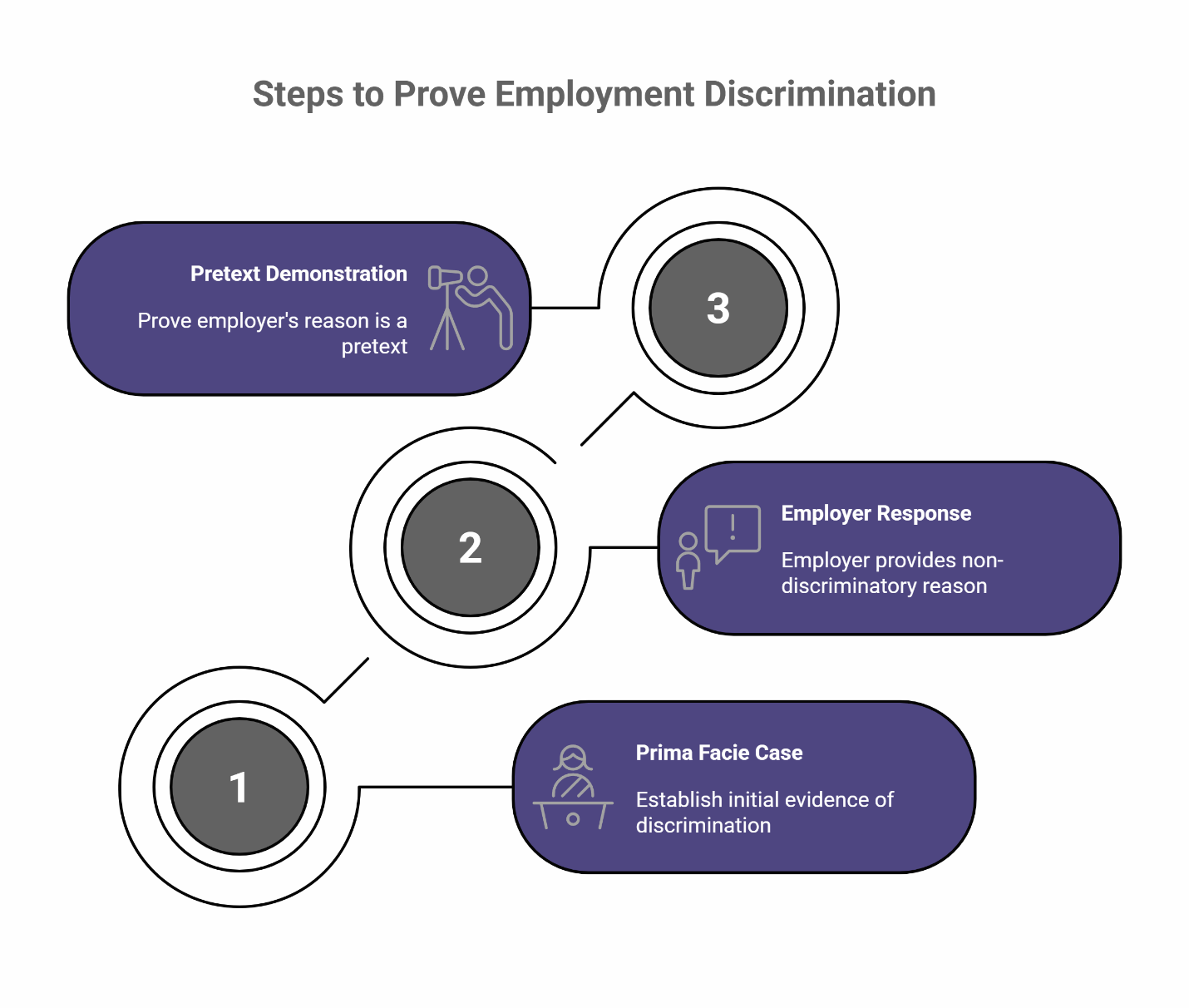
The burden-shifting framework creates a systematic approach for evaluating discrimination claims. This framework typically involves three sequential stages:
- Prima facie case establishment – demonstrating membership in a protected class, qualification for the position, an adverse employment action, and circumstances suggesting discriminatory intent.
- Employer response – requiring the employer to articulate a legitimate, non-discriminatory reason for its action.
- Pretext demonstration – showing that the employer-provided justification constitutes a pretext for discrimination.
The critical third stage requires demonstrating that the employer-provided justification is pretextual. This analysis may involve showing the stated reason is factually inaccurate or proving that while technically accurate, it was not the genuine motivating factor. The trier of fact (judge or jury) may examine the consistency of employer actions, the timing of decisions, and the comparative treatment of employees when evaluating pretext claims.
Legal advice depends on the specific facts and nuances of a situation, which a qualified employment law attorney can evaluate. You should contact an attorney specializing in employment discrimination law for guidance on your specific situation. This framework is applied in New Jersey with the recognition that performance-based discrimination can involve sophisticated methods designed to appear legitimate. The intersection of federal Title VII protections with NJLAD provisions creates concurrent remedies for individuals experiencing such discrimination.
Established Pretext Applications in Performance Review Contexts
Performance evaluation systems present unique opportunities for discriminatory application while maintaining apparent objectivity. Patterns may emerge when employers use subjective evaluation criteria differently across demographic groups or implement standards inconsistently based on protected characteristics.
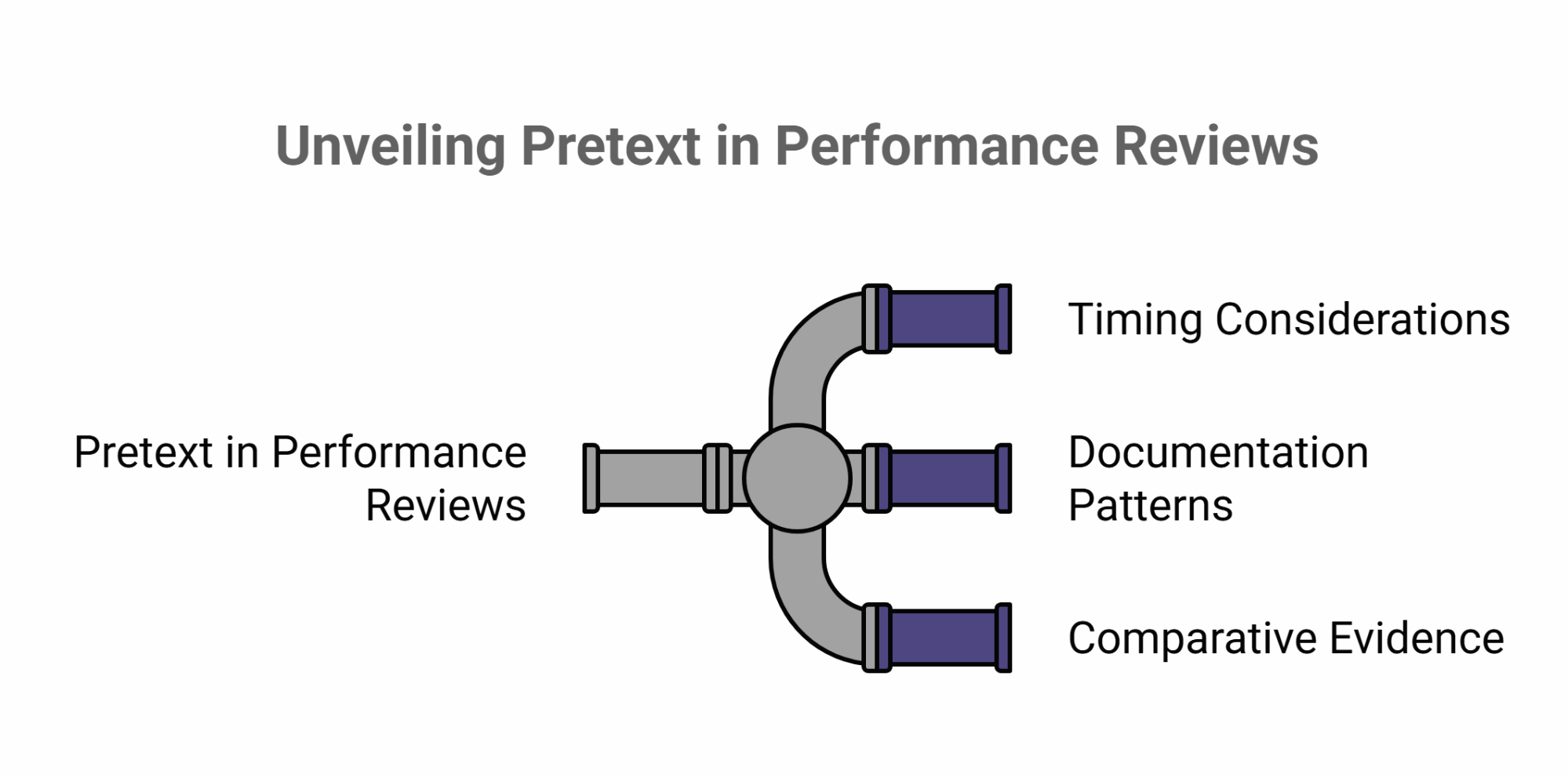
Timing considerations often provide crucial evidence. Performance evaluations that shift negatively following a protected class-related event—such as a pregnancy announcement, a request for religious accommodation, or the filing of a discrimination complaint—may indicate pretextual motivations. In a legal proceeding, the trier of fact may examine whether negative performance assessments correlate with protected activity or a change in status rather than with actual job performance.
Documentation patterns can reveal important evidence. When performance concerns appear suddenly without prior warning, lack specific examples, or contradict previous positive evaluations, these inconsistencies may support a finding of pretext. Similarly, when evaluation criteria change without business justification or when standards become more stringent for members of a protected class, such patterns may suggest discriminatory application.
Comparative evidence plays a central role. If similarly situated employees outside of a protected class receive different treatment for comparable performance issues, this disparity may be used as evidence of discriminatory intent. Corporate performance management systems often provide detailed records for comparative analysis.
The complexity of proving pretext requires an understanding of sophisticated legal standards and evidentiary requirements. Due to their complexity and the significant consequences of procedural errors, professional legal representation is typically necessary for these types of employment discrimination matters.
+——————————————————————————————————-+
💡 Quick Takeaways
- Timing Evidence: Performance shifts following protected activities may indicate discriminatory pretext.
- Documentation Patterns: Sudden concerns that lack prior warnings or specific examples may suggest unlawful motivations.
- Comparative Treatment: Applying different standards for similar performance across demographic groups can be an indicator of potential discrimination that warrants professional consultation.
+——————————————————————————————————-+
Recognizing Discrimination Indicators Through Legal Standards
Seemingly objective performance management processes can sometimes be applied with discriminatory intent. Legal standards help identify when legitimate business practices may be used as vehicles for unlawful discrimination.
Inconsistent application of performance standards represents a primary indicator of potential pretext. When evaluation criteria shift without business justification, or when previously acceptable work suddenly becomes problematic, these patterns may indicate discriminatory application.
Subjective evaluation criteria present particular vulnerabilities. Terms such as “cultural fit,” “leadership potential,” or “communication style” may mask discriminatory judgments about protected characteristics. When these subjective assessments correlate with demographic patterns or contradict objective performance metrics, they may constitute evidence of pretext.
Corporate performance management software can create detailed electronic records that may reveal discriminatory patterns. These digital trails can provide objective evidence of inconsistent standard application or suspicious timing that supports a pretext analysis.
During a potential or pending legal dispute, all social media activity requires particular attention. It is often advisable to avoid using social media entirely during a legal dispute, as posts, comments, and other activity may be scrutinized as evidence. A qualified employment attorney can provide specific guidance on this matter.
When Professional Legal Consultation Becomes Essential
Understanding the pretext doctrine requires recognizing the complexity of legal analysis and evidence evaluation. An employment discrimination attorney can assess whether observed patterns may constitute actionable pretext and provide guidance on evidence preservation.
The New Jersey Division on Civil Rights provides an administrative process for addressing discrimination claims. While the NJLAD generally provides a two-year statute of limitations for filing a lawsuit, the deadline to file an administrative complaint with the New Jersey Division on Civil Rights is much shorter—typically 180 days. These strict deadlines create an urgency for timely legal consultation when discriminatory patterns emerge.
Professional consultation becomes particularly important when:
- Performance reviews show patterns inconsistent with previous evaluations.
- The timing of the review coincides with a protected class-related event.
- Comparative treatment suggests discriminatory motives.
- Data from corporate performance systems reveal patterns that may constitute evidence.
Employment discrimination law involves complex procedural requirements, strict deadlines, and sophisticated evidentiary standards that require professional legal expertise. The intersection of corporate performance systems with anti-discrimination law creates nuanced legal questions that require a qualified legal evaluation. Attempting to handle an employment discrimination matter without professional assistance carries significant risks.
A qualified employment attorney can evaluate individual circumstances, assess the strength of the evidence, and provide strategic guidance. Given the sophisticated nature of corporate discrimination and pretext analysis, professional legal consultation is essential for the protection of your rights.
Frequently Asked Questions
What is pretext in an employment discrimination claim?
Pretext occurs when an employer’s stated reason for an adverse employment action is found to be untrue or not the actual motivation. Proving pretext involves a complex legal analysis of evidence, timing, and the comparative treatment of employees. Because the application of this doctrine depends on the specific facts of a case, a professional legal evaluation is necessary.
How is a pretext claim analyzed in New Jersey?
In New Jersey, the analysis typically follows a three-step process. First, the employee presents a basic (prima facie) case of discrimination. The burden then shifts to the employer to provide a legitimate, non-discriminatory reason for its action. Finally, the employee must show that the employer’s reason is a pretext for discrimination. This legal framework requires careful navigation of procedural and evidentiary rules, underscoring the need for guidance from a qualified attorney.
When should I consult with an attorney about a potentially unfair performance review?
You should consult with a qualified employment attorney if you believe a performance review is unfair, especially if it is inconsistent with your past performance, follows closely after a protected activity (like requesting medical leave), or if colleagues in different demographic groups are treated more favorably. Given the strict deadlines for filing claims under the NJLAD, which can be as short as 180 days for an administrative complaint, you must seek legal advice promptly to protect your rights.
Disclaimer: This content is for informational purposes only and does not constitute legal advice. No attorney-client relationship is formed by viewing this content. You should consult a qualified attorney for advice on your specific situation. The laws and deadlines mentioned are subject to change, and you should verify any legal requirements with official sources or a legal professional.
Protect Your Career—Know Your Rights
At Zatuchni & Associates, we understand how subtle and sophisticated workplace discrimination can be—especially when hidden behind performance reviews and internal metrics. With over two decades of experience representing professionals across New Jersey’s most competitive industries, we bring deep legal insight and strategic expertise to every case we handle.
If your performance evaluation feels suspicious or unfair, you don’t have to navigate the uncertainty alone. Our attorneys specialize in uncovering pretext and holding employers accountable under New Jersey’s strong anti-discrimination laws.
➡️ Concerned about a recent performance review? Contact us today for a confidential consultation with a race discrimination attorney who can help you evaluate your legal options.
🔍 Want to learn more first? Browse our site to explore how we’ve successfully represented employees facing workplace discrimination—and how we can help you do the same.
Your career, reputation, and future matter. Let our team help you protect them.
You must be logged in to post a comment.