
📌 Key Takeaways
Retaliation Protections Operate Independently: New Jersey law potentially recognizes retaliation as a distinct statutory violation under NJLAD, separate from underlying race discrimination claims. Retaliation protections may apply even when the original discrimination claim faces challenges or cannot be proven, creating dual legal frameworks that operate simultaneously.
Good-Faith Belief Triggers Protection: Protected activity under New Jersey law centers on an individual’s reasonable, good-faith belief that discrimination occurred—not whether discrimination can ultimately be proven. Formal and informal complaints about perceived race discrimination may trigger anti-retaliation protections, regardless of whether the underlying discrimination claim would withstand legal scrutiny.
Adverse Actions Extend Beyond Termination: Materially negative changes in employment terms may constitute retaliation, including but not limited to termination, demotion, reassignment to less desirable positions, negative performance evaluations departing from established patterns, exclusion from professional development opportunities, and changes in compensation terms.
Time-Sensitive Legal Considerations: New Jersey law imposes time limits for filing discrimination and retaliation complaints. The complexity of analyzing whether specific circumstances constitute protected activity and actionable retaliation involves fact-specific legal analysis beyond general information. Contact a qualified New Jersey employment attorney promptly to evaluate specific circumstances.
Understanding how race discrimination complaints may trigger independent retaliation protections helps individuals recognize when workplace experiences potentially implicate multiple legal frameworks under NJLAD. This content is for informational purposes only and does not constitute legal advice. Laws are subject to change; consult the New Jersey Division on Civil Rights or review official statutory materials for current information. Contact a qualified New Jersey employment attorney for case-specific evaluation of particular circumstances, as individual situations require professional legal analysis.
When professionals speak up about race discrimination in New Jersey workplaces, the complaint itself may trigger additional mistreatment.
New Jersey’s Law Against Discrimination (NJLAD), N.J.S.A. 10:5-1 et seq., potentially addresses both the underlying discrimination and subsequent retaliatory conduct. These protections operate independently—opposing discrimination becomes protected activity separate from whether the discrimination claim succeeds.
The intersection of race discrimination and retaliation involves complex legal analysis requiring fact-specific evaluation. Contact a qualified New Jersey employment attorney for assessment of particular circumstances. Laws are subject to change; consult the New Jersey Division on Civil Rights for current requirements.
Protected Activity: When Opposing Race Discrimination Triggers Legal Protections

New Jersey law establishes that opposing what an individual reasonably believes to be discriminatory conduct may constitute protected activity under NJLAD. This protection extends to:
- Formal complaints through official channels
- Informal objections raised with supervisors
- Verbal expressions of concern about discriminatory practices
The critical element centers on the individual’s reasonable, good-faith belief that discrimination occurred—not whether discrimination can ultimately be proven.
Professionals who observe differential treatment in promotion decisions based on race and raise concerns may engage in protected activity. The statutory framework potentially protects this opposition regardless of whether the underlying discrimination claim would withstand legal scrutiny.
Because determining what qualifies as protected activity involves fact-specific legal analysis, contact a New Jersey employment attorney to evaluate whether particular actions may receive statutory protection.
The Retaliation Framework: How New Jersey Law Addresses Adverse Actions Following Discrimination Complaints
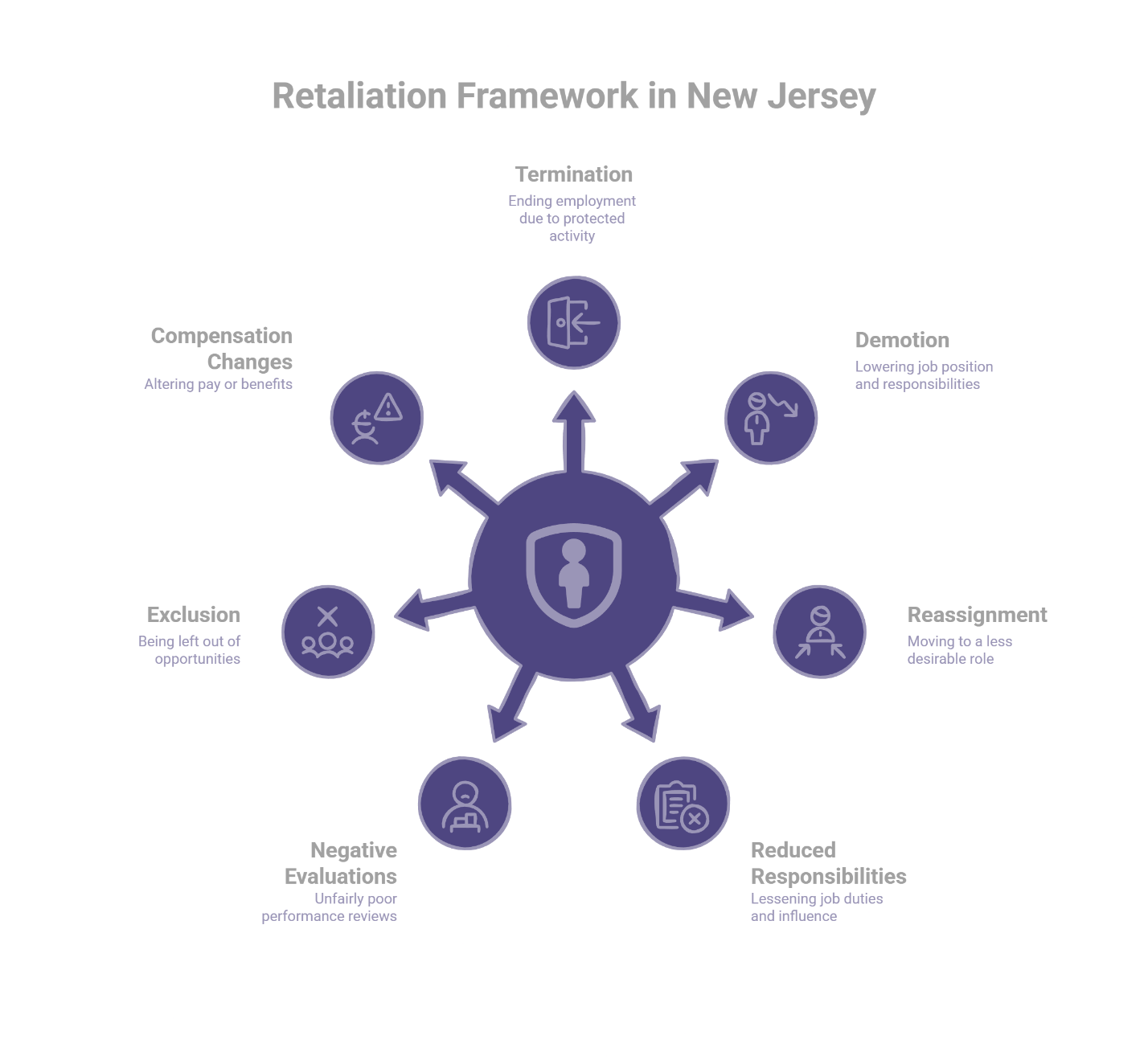
NJLAD’s anti-retaliation provision, N.J.S.A. 10:5-12(d), establishes retaliation as a distinct statutory violation separate from underlying discrimination. Adverse employment actions that follow protected activity may constitute retaliation when a causal connection exists between the opposition and the subsequent employment action.
Adverse employment actions encompass materially negative changes in employment terms and conditions, including but not limited to:
- Termination
- Demotion
- Reassignment to less desirable positions
- Reduction in responsibilities
- Negative performance evaluations departing from established patterns
- Exclusion from professional development opportunities
- Changes in compensation or benefits
The law potentially recognizes both formal employment actions and subtle changes in workplace treatment that materially affect professional standing.
Warning: Establishing a causal connection between protected activity and adverse action involves fact-specific analysis beyond the scope of general information. New Jersey law imposes strict statutes of limitations for filing discrimination and retaliation complaints. Contact a qualified New Jersey employment attorney promptly to preserve legal options. Qualified attorneys can evaluate whether particular circumstances potentially involve actionable retaliation under NJLAD.
Why the Intersection Matters: Understanding Dual Protections
The independence of retaliation protections from underlying discrimination claims creates dual legal frameworks operating simultaneously. New Jersey law potentially recognizes retaliation as a violation even when the original race discrimination claim faces challenges or cannot be proven.
Key distinction: Retaliation claims may succeed independently because they address different conduct—the retaliatory response rather than the underlying discriminatory practice.
Individuals who complain about perceived race discrimination might later face termination or career stagnation. Even if establishing the original discrimination proves difficult, NJLAD’s anti-retaliation provision may provide protection if adverse actions followed the complaint and a causal connection exists between the events.
These situations involve multiple intersecting legal issues with serious career and financial implications. Contact a qualified New Jersey employment attorney for evaluation of specific circumstances before making decisions that could affect legal rights. For current information, consult the New Jersey Division on Civil Rights, as legal requirements are subject to change.
Frequently Asked Questions
Can I have both a race discrimination claim and a retaliation claim under New Jersey law?
New Jersey law potentially recognizes race discrimination and retaliation as distinct violations under NJLAD. An individual might experience race discrimination and subsequently face retaliation for opposing that discrimination, creating two separate legal issues. These claims may proceed independently.
The key factors typically include:
- Whether the individual engaged in protected activity
- Whether adverse employment actions followed
- The causal connection between the protected activity and adverse actions
Because these situations involve complex legal analysis requiring evaluation of specific facts against established legal frameworks, contact a qualified New Jersey employment attorney to assess whether particular circumstances potentially involve multiple violations.
Frequently Unasked Questions
Does the strength of my underlying race discrimination claim affect whether I have retaliation protections in New Jersey?
This represents a commonly misunderstood aspect of New Jersey employment law. Under NJLAD, retaliation protections may apply even when the underlying discrimination claim is weak, contested, or ultimately unsuccessful. The key inquiry focuses on whether the individual held a reasonable, good-faith belief that discrimination occurred and opposed that perceived discrimination.
Critical legal principle: New Jersey law potentially protects individuals who oppose conduct they reasonably believe to be discriminatory, even if that belief later proves incorrect.
This means:
- Retaliation claims may succeed even when discrimination claims fail
- The analysis focuses on whether the individual reasonably believed discrimination occurred
- Good-faith opposition receives protection regardless of claim outcome
However, these determinations involve highly complex, fact-specific legal analysis. What constitutes “reasonable belief” varies significantly by circumstance, and not all complaints automatically qualify for protection.
Contact a qualified New Jersey employment attorney for case-specific evaluation. Attempting to navigate these issues without qualified legal guidance could result in loss of legal rights.
Disclaimer
This content is for informational purposes only and provides general educational information about New Jersey law. This content is not legal advice. No attorney-client relationship is formed through this content. Laws are subject to change, and legal requirements may vary based on specific circumstances.
Please consult a qualified New Jersey employment attorney for legal advice specific to your situation. For current legal information, consult the New Jersey Division on Civil Rights or review official statutory materials.
This information addresses New Jersey law; other jurisdictions may have different legal frameworks.
Ready to Understand Your Rights and Protect Your Career? We’re Here to Help.
At Zatuchni & Associates, we’ve spent years advocating for New Jersey workers facing race discrimination and retaliation. Our experience handling complex NJLAD matters allows us to provide clear guidance, trusted legal evaluation, and dedicated representation for professionals navigating these difficult circumstances.
If you believe you’ve experienced discrimination or retaliation—or you’re unsure how the law applies to your situation—our team is ready to assess your circumstances with the attention and care you deserve. Contact us today to speak confidentially with a qualified New Jersey employment attorney.
You must be logged in to post a comment.